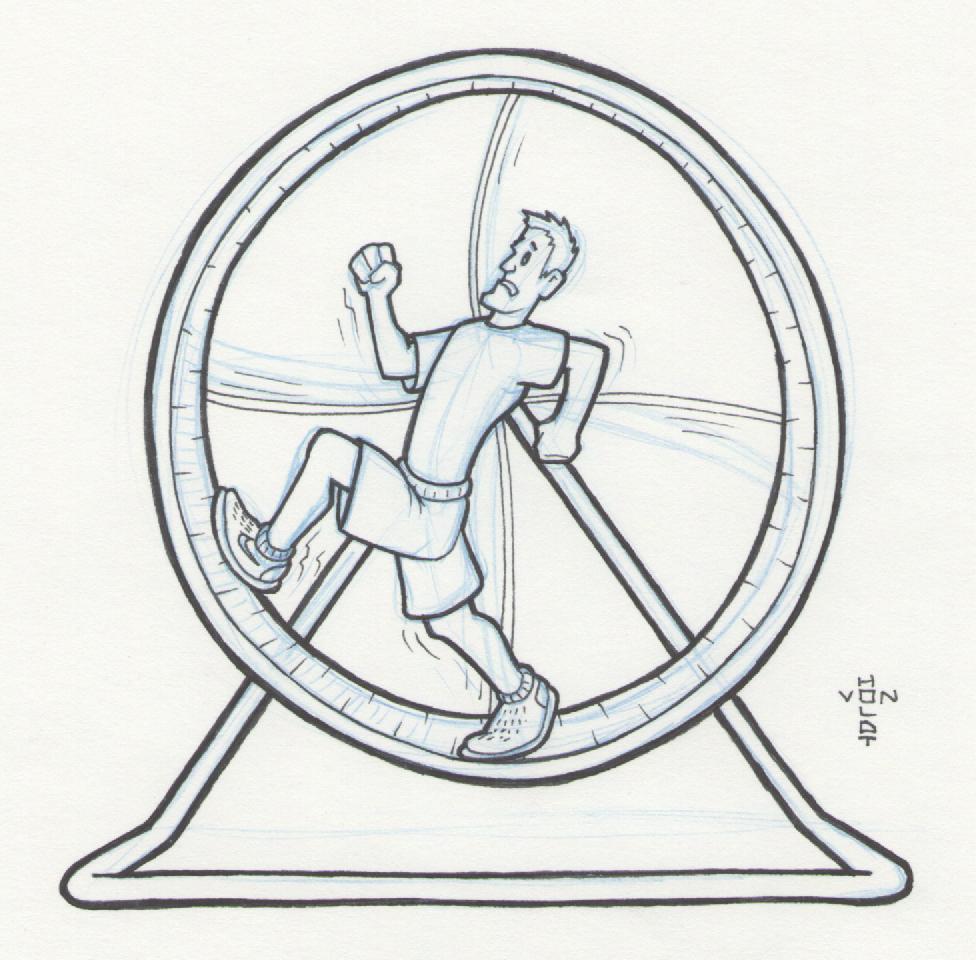
Showing posts with label fats. Show all posts

Monday, January 19, 2015

Is This Food Healthy?

One of the most-often asked questions from people who are trying to manage their weight is "what should I eat?"  I've spent a long time on the fence about whether to EVER write a post like this.  But, since the question will never, ever go away entirely, I'm going to do my best to give readers a simple set of guidelines to evaluate their food choices.  Because, if you go based on the banner labels splashed across practically every box, can, or jar in the grocery store, it's ALL good, baby!

Attention Monkey Island:  Let me say right up front that I KNOW that there are plenty of holes you can poke and stones you can throw.  I'm not setting a "good food/bad food" standard here.  I'm just trying to give people a tool to help them evaluate their food choices.  That  said, load up; I love an energetic debate.

First, we have to set some ground rules.  With very few exceptions, we don't believe in classifying food as "good or bad".  We're more likely to classify something as "barely food" based on its ingredients and nutritional content, but that doesn't make it "bad".  Second, a lot of what makes a particular food a "good or bad" choice has to do with your overall nutrition plan and how it fits with your training plan.  While I'm not exactly an "if it fits your macros (IIFYM)" guy, there's more than a grain of truth to it.  And finally, we are not calorie counters (and I don't think you need to be either).  So this guide isn't going to help you hit a "magic number" on a reduced-calorie nutrition plan.  

What we DO believe in is putting quality food in your body.  So, as we attempt to answer the age-old question "is this food healthy," that is my foundation.  

Breaking the pattern.  
This "healthy" choice (just look at the yellow
banner) gets over 60% of its calories from sugar!
You might as well pop Jolly Ranchers.
If you're like most people, then you'll choose a "healthy" food based on a carefully laid out pattern.  You'll read the banners (high fiber! low fat! gluten free!), then you'll head to the label and look at the calorie count (which is per serving, so has little bearing on how much you will actually consume).  Then, because fat is bad, you'll swing down to the fat grams and gasp!  Finally, you'll scan the vitamins/minerals section.  Then, with those four data points, you'll make your calculation.  Something like, "hmm, low(ish) calories, low fat, and lots of vitamins; this is good for me." Oh boy!  Here's the pattern I recommend.

Go straight for the sugar content.
It's a sub-section under the carbohydrate part of the nutrition label.  I'm reluctant to give a hard-and-fast rule on this, but let's just say that if 15% or more of the calories per serving are coming from sugar, that's a red flag.  Also look at the ratio of sugars to total carbohydrates (in grams).  You want more complex carbs and fiber content.  So the higher the proportion of sugars to total carbohydrate, that's another red flag. 

Second, head to the ingredients section.
We've got a few things to do here.  Start by looking at the number of ingredients as a whole.  The longer the list, the more you have to consider this might not be the best option for you.  

I can feel Monkey Island loading up their slings, so let me explain why.  Your body is designed to absorb macronutrients (protein, fat, and carbohydrate) and micronutrients (vitamins and minerals) through digestive enzymes that promote absorbtion into the body.  There are all kinds of things you can eat that aren't toxic, but aren't part of your digestive design either.  


Sure, you can eat 'em.  That doesn't make them food!
Your body has to figure out what to do with those things (think about all those laxative commercials you see).  Also, an awful lot of foods that have reduced fat or sugar content have to rely on a host of other additives to make up for the taste, texture, consistency, and cooking behaviors that fat and sugar would normally provide.  This effectively transforms what you traditionally think of as the nutritional profile of a food into something else entirely.  So - I say the shorter the ingredient list, the better.

While you're looking at the ingredients, look for "partially hydrogenated" anything.  At this point, I'd just put it back on the shelf.  These are the kinds of highly processed fats and oils that make a food last a really long time on the shelf, but they're particularly nasty when it comes to producing the LDL cholesterol that is so damaging.  

Third, look at the proportions of protein:fat:carbohydrate.
Go back to the nutrition label and compare the grams for each of the macronutrients.  If you've already put down the sugar-heavy stuff from step one, then just understanding whether this food is primarily a source of protein, fat, or complex carbs is important.  Which one is best?  It honestly depends on the rest of your nutrition plan.  My goal is to get one gram of protein per pound of lean body weight, so I try and prioritize that first.  But you know which piece fits your plan.

TIP:  Apps like Foodle will help you learn the macro content of fresh whole foods (as well as a number of processed options).  Getting a good basis in what the fresh stuff offers will help you compare the quality of similar pre-packaged options.  And Fooducate will give you a letter grade for an item just by scanning the bar code.

Fourth, go to the expiration date.  
Fresh meats last 4-7 days.  Fresh produce: a week or so.  Fresh bread: 3-5 days.  If the expiration date seems excessively long (months, years???), then it's loaded with preservatives or so hyper-processed that it's nutritional frankenstein, and I'd steer away from it for a fresher choice.  Canned goods are an obvious exception.

So that's it: my formula for determining whether a food item goes in the cart or back on the shelf.  The fact is that the majority of what we eat doesn't come with a nutrition label, because we tend to operate mostly in the fresh produce and meats section of the store.  But we're not fanatics about it. And, sometimes, convenience foods offer something you need to fit in your lifestyle.  With these tips in mind, make your next trip to the grocery store one where you can take your time and make some comparisons.  I'd love to hear what you find. 

Tuesday, August 13, 2013

Obesity's Perfect Storm

There's something going on in the Western World.  And, despite so much attention being focused on it, it's still getting worse.  The average westerner has lost touch with the innate ability to feed and, thereby, care for ourselves.  People are getting heavier and sicker by the day.  We're more educated, have a higher living standard, and medical science is more advanced than ever before.  How are we not getting the message?

It must be something bigger.


I'm not a conspiracy theorist.  But I do believe in complexity.  And the more I learn, the more I see a "perfect storm" of factors that have come together to, quite literally, shape our society.  To peel it all back, let's take each factor one at a time.

Storm front #1: Flawed Science
It really all starts here.  Whether you agree with his "carbs are the real problem" stance or not, in his book, Good Calories, Bad Calories, Gary Taubes paints a fairly dismal picture of the evolution of medical science with respect to weight and health management.  The foundational focuses are decades old and were based on the limitations of what was known and what could be measured at the time.  These foundations have endured over time and, like a crooked wall, veer ever farther from the original premise.

Scientific studies can do as much harm as good.  This is no critique (necessarily) of the researchers themselves, but more of the instant-gratification, dumb-it-down media to immediately take things out of context and beyond the scope of the study.

These days, the focus is on "curing" obesity.  It was even recently designated a disease.  Open the door for "there's a pill for everything" medicine.  Family practitioners are not up to speed on nutritional science breatkthroughs, and are also less likely to explore lifestyle treatment, like meaningful physical exercise.  The lifestyle mantras are quoted chapter and verse by doctors across the world: get 30 minutes of cardio, 2-3 times a week and eat less fat.  But there is little expectation that patients will follow this advice, so very little emphasis is put on the importance of lifestyle and health.

Specialization also takes a toll here.  Diabetologists and endocrinologists are on the front lines of the impacts of obesity.  But those specialists come into the picture after things are well out of control, and "downward" communication to your family doctor isn't happening the way it should.  Instead, the entire focus has been put on calories in vs calories out, rather than on how to nourish and power our bodies.

Storm front #2: "Big Fitness"
The fitness industry, from big box gyms to "as seen on TV" wonder DVDs and gadgets, to the purveyors of miracle supplements and shakes, is a mult-billion dollar industry.  And its customer base is growing.  There is no incentive for the fitness industry to actually get you into shape.  In fact, they'd rather make you dependent on their products and keep you coming back as a return customer.   If you buy a gym membership and never go, the gym still gets your money and the equipment you would be using remains vacant for yet another member.  It's a win/win for the fitness center.  And nothing you buy from TV is ever going to deliver the results promised.  They even tell you that, right on the screen: "results not typical".

Storm front #3: "Lifestyle Marketing"
Can I have a side of Diabetes with that?
I'm in the marketing industry myself.  Everybody is looking for that fundamental emotional connection to make with their customer.  Lifestyle marketing is when you tie your product to a way of life, a feeling of prosperity, happiness, and success.  The tactics are incredibly successful.  Now think about the last restaurant commercial you saw.  Was it really about the food?  Or were there images of attractive people having a great time while eating food?  If you want to have a good time with friends, what is the first thing that comes to mind?  A meal out somewhere?  Where did that come from?

Now think about the advertising for "convenience foods" that pepper the television.  What are the underlying messages there?  Cooking is hard and you don't have time.  Your family will love you for serving this dish.  Plus: hey! added fiber / reduced fat / naturally sweetened - you name it.  Bottom line: this is better than what you could possibly pull off on your own.  Nonsense, I know.  But we, as a society, are completely in the thrall of the convenience food message.  

Storm front #4: "Addictive Flavors"
On the first three points, we are talking about information that is widely available and completely up to the reader to make an informed decision.  Let the buyer beware, right?  But, when it comes to addictive flavors, this is the one topic where I will point a finger at a malignant source.  

Food companies consult with flavor labs to create the perfect balance between a distinctive flavor and a very limited finish.  When the food is in your mouth, the texture and flavor are extremely pleasing, but, in these engineered flavors, the moment you swallow, you need a "boost" to get the flavor back.  It literally keeps you coming back for more.  

We haven't been eating clean for that long: just over a year.  I still remember foods that I loved.  They were my go-tos week after week.  We recently drove across the country and hit some pretty austere territory in the process.  Our choices were limited.  I literally had McDonalds for the first time in 13 months.  It tasted like - nothing.  Nothing at all.  Place after place we stopped, it was the same story.  Safe to say, we were sort of stunned.  When you're used to real food.  The stuff you used to think of as craveable is just a pale shadow of flavor.  And that's the way they design it.  

Storm front #5: "Pop Media"
Have you noticed that when you flip through five different news broadcasts, they're all on the same stories?  That's because they all take their information off the same news wire.  We are obsessed with the sound bite and the news feeds us exactly what we want.  When a study that took five years to conduct and comes with four hundred pages of findings is reduced to a two-minute blurb read by a talking head from a teleprompter, it's fairly safe to say that you aren't getting the nuances.  

Take the recent story on Omega-3 fatty acids.  The study took participants who had prostate cancer and examined their blood chemistry to see if there were any trends.  They found that some of these participants had elevated levels of Omega-3 DHA.  There was a correlation between these participants, all of whom had cancer, and blood levels of this fatty acid.  Of course, people at risk for prostate cancer (men over 50) have been bombarded with messages about supplements that will reduce their risk or the severity of the cancer.  Did they have elevated levels because they were fighting cancer, or was the cancer a result of the Omega-3?  Or... was some other element of body chemistry out of whack that contributed to both the cancer and the blood lipid levels?  The study confessed not to know.  But the news story said "Taking fish oil is associated with an increased risk of prostate cancer."  Period.  

Beyond the news, you run into an endless stream of "talk" shows that are, at best, the blind leading the blind, and at worst, a serious conflict of interest.  People who profit from the endorsement of a product on their forum should be regarded with skepticism, especially when it comes to your health.

Storm front #6: "Urban Myths"
The Internet is a fabulous thing, isn't it?  I mean, you're enjoying our fabulous content right now thanks to the "information superhighway".  But the Internet is a peculiar paradox.  On one hand, it has nutured our craving for instant gratification.  There is always something new to grab your attention.  On the other, it is a vast repository of things that just won't die.  In my military life, when you got a new regulation or new set of orders, they would always tell you that the previous version was obsolete and you should get rid of it.  That was nice.  It was clean and simple.  The new guidance is the only guidance.  

Not so in our modern world.  Everything gets mixed up.  This will save you, that will kill you.  Then tomorrow the whole thing is reversed.  The result is that people hold on to whatever piece of information struck them first or resonated the most, with a healthy dose of skepticism for anything that conflicts with what they perceive to be the truth.  And, with the Internet, they can perpetuate it through a host of different channels, continually re-muddying the waters.  

People mean well.  They believe that their information is the right information.  But there is very little to help you, the reader, from separating established fact from outdated convention from plain ol' poppycock.  

Superstorm: Obesity
By themselves, none of these "storm fronts" would do much damage.  But the way they've coalesced into a combined power, it has colored our perception in a profound way.  Look at how these look when they're strung together into one set of attitudes about food and fitness:

     "I'm overweight, and I know I need cardio exercise three times a week to burn fat, plus I have to watch my fats and cholesterol.  Fiber's great though, so I should eat more grain.  Plus, I drink green tea every day, since it's a fat-burner.  I have a membership at a great gym; they have all these cool classes and tons of treadmills and elliptical machines, plus I bought that "Turbo Jam" DVD, so I can tone and shape my muscles.  It really makes me sweat."  

     "I eat pretty healthy; I only buy low-fat and low-calorie foods. Except on weekends, because that's when I go out with my friends.  Dinner, drinks and dessert are such a great way to unwind and I deserve a little reward.  I'll just work out twice as long on Monday.  When I'm hungry, I usually have an extra bowl of Special K, because it's heart healthy and "they" say the studies show women who eat this weigh less.  Besides, it's delicious! I could eat a whole box of that stuff every day."  

     "I'm not sure why I'm not losing weight.  I don't eat eggs, cheese, or meat hardly ever; I only drink diet soda now, and I've been taking Hydroxycut for months.  I only eat 1200 calories a day (when I don't cheat).  I'm just so tired all the time.  I have no time or energy to go to the gym, let alone cook a lot of crazy food.  I feel bad, because I've paid for the membership, but I'll get back in there soon.  Guess I'll microwave dinner; it's Healthy Choice at least."

Do these sound like anybody you know?  Do you see the subtle influences of the six "storm fronts" across them all?  

How about this one?

     "I love food!  It seems like I'm eating all the time.  Steak, cheese, and full-fat Caesar dressing?  Bring It!  I can't remember the last time I had a bowl of cereal.  I have a vague idea of how many calories I'm eating, but I don't count and don't really care.  I  never jog or hit the elliptical.  The best thing is all the great flavors I get to eat: Mexican, Greek, Chinese, and Italian.  Besides, I save a ton of money by eating at home."

This person is obviously unconcerned about his or her health.  A walking time-bomb, right?  Well, the truth is, this is a declaration that Michelle and I have both made more than once.  In fact, though it is only part of the story, it is a big part of our attitude toward nutrition now.  It flies in the face of everything you know about eating healthy, right?  How could we possibly lose weight with such a bizarre approach to nutrition?  

I'll repeat what I said at the beginning: something is wrong - something bigger than "eat less, move more".  We believe that we have found a winning approach to nutrition and fitness.  I won't say "right" because your goals may be different.  But if you want to lose fat, be stronger, have more energy, and feel great about how you feel and look, then you've come to the right place.  You've got to shed the conventional wisdom, choose a nutrition plan (not a diet) and a training plan (not exercise) that will deliver the results you want.  

Thursday, June 13, 2013

How the Calorie Ruined Nutrition

Okay - that's it - I've had all I can take...

I know we are going to start a storm here, but, day in and day out, we keep seeing the same mythology and misunderstanding being perpetuated around the Internet, the water cooler, and forums across the web.  It's time to try and put it to rest.

The dietary Calorie, a brief history:


The Calorie, in its modern definition, came from  roots in mechanical physics at the time that the steamboat and the steam engine locomotive were the height of technology.  It was, as today, a measure of heat energy to quantify the effects of fuel on a thermal engine.
 In the mid-1800s, this concept became adapted to food consumption, though the measurement was transformed into the more practical Kilo-Calorie (kcal).  The concept was introduced to the public by Atwater in the journal "Century" in a series of articles.  Ironically, even at this early stage, scientists acknowledged that "The potential energy represents only the fuel value of the food, and hence is only an incomplete measure of its whole nutritive value".

As a unit of energy, the calorie has long been surpassed by the joule, but the term Calorie has become so embedded in our nutritional awareness, that it has never been replaced.

The method of determining the caloric value of food is the same as it has always been: a calorimeter, which combusts the food in a laboratory and records the heat energy generated.  Which is great, if you're a pot-bellied stove.

What's wrong with the Calorie?

This obsession with food = calories = energy = balance to be maintained and manipulated is baffling.  Somewhere along the way, we forgot about the difference between energy and matter.  Energy that exists solely as energy can be found in all kinds of places: light, heat, radiation, house music... well, maybe not house music.  Matter, on the other hand, has mass and takes up physical space in the universe.  Which category do you think your chicken breast falls into?

The whole calorie theory rests its ponderous bulk on the First Law of Thermodynamics, that energy cannot be created or destroyed, only transferred or converted.  Fine and good, except that, as matter, the things we eat as food also have the laws of physics surrounding them.  As finite quantities of molecules, you can't burn them and build with the same piece.  You have to choose.  

YES, okay, the chicken breast can potentially be used as energy.  And some of it certainly will be.  But some of it, depending on your age, metabolic health, training routine, and other factors, possibly most of it will be applied to replacing worn out tissues and building new ones.  

Think of a steak.  When it is on your plate, you look at it as "X" calories per serving.  But, in the cow, it wasn't energy; it was muscle tissue.  Stored protein that did work and burned energy.  Yes, if the cow were starving, that muscle tissue would eventually be catabolized into energy to keep the cow alive.  But then the cow wouldn't have the muscle anymore.  You can't burn it and build with it.  You have to choose.

Somewhere along the way, we took a wrong turn...

Something happened in our advanced society.  Somewhere we lost the ability to think and reason for ourselves.  Worse, some pompous scientists started bashing anybody that disputed the immutable laws of physics when it came to food - completely ignoring the fact that they had skipped a chapter along the way.  I'm not a pot-bellied stove.  The stove isn't going to take any of the wood you throw in it and use it to reinforce the iron base, or replace the stovepipe molecules that have degraded in the heat.  Nope, it's just going to burn stuff.  I'm not a pot-bellied stove.
ourselves.  Grandma used to say "eat your meat and vegetables; they'll make you grow up big and strong."  We used to think of food as nutrients, as building blocks.  In short: matter.  But some knucklehead started slapping the caloric value of every piece of food on a label and we lost our minds.  Calories became everything.

If food is just a collection of calories and calories are interchangeable, then why do some people get fat and some get muscular?  Why is there any variation in body composition between two people that eat the same thing?  Why can some people lose weight on 1800 kCal a day and others feel the need to plummet to 1000?  

And it gets even more ridiculous!

Since people abandoned their own experience for the wisdom of a food label, they have gone to unbelievable lengths to create the "perfect equation" of energy balance.  From measuring calories in, to Basal Metabolic Rate, to calories burned in exercise, we have heaps of calculators and tools to show us how to strike the magical energy balance.  And none of them, no matter how complex, are right.  

Futility, Part 1 - Calories in.


Calorie counters read those labels religiously. They add them all up, weigh, measure, and portion so exactly right.  But - there is so much variation between those labels and the actual content of food, sometimes as much as 50% above or below, that, from the outset you're doomed to arrive at any meaningful number.  Add to that the variation in cooking techniques and, well, you get the idea.  

What's more (and I'm going out a scientific limb here) many of the so-called "foods" we eat in a modern society are either barely digestible at all or so refined the body sucks it up at alarming rates.  The best documented example of this is baby formula.  Scientific studies have conclusively proven that much less of the processed and artificial nutrients used to simulate breast milk are not absorbed into the body, but passed straight into the stool.  Their solution, multiply these ingredients by the inefficiency of absorption to "force" sufficient nutrient into the baby's system.  But what happens to the rest of it?  How does it impact the digestive tract?  Anybody who has changed diapers of both breast-fed and formula babies will tell you.  

Paleo practitioners, on this score, have it right.  Though the specifics of "what" are still in dispute, there is no doubt our body was constructed and equipped to digest and process certain molecules better than others.

Futility, Part 2 - Basal Metabolic Rate (BMR). 


Apparently there is an app for that...
The next piece in the calorie-counting nightmare is calculating BMR.  There are all sorts of Theory of Relativity-rivaling calculators out there that estimate your activity level, adjust for the Thermic Effect of Food, and factor in other components like age and gender.  These calculators are supposed to spit out the amount of energy you burn just existing.  

But again, every person is unique in their combination of body composition, metabolic health, hormone levels, perceived level of activity, and even the efficiency (conditioning) with which their body operates.  Conditions such as stress, fatigue, and even the weather add further variables to your actual daily energy expenditure.  

So we start with a calculator based on estimates and subjective factors, leave out individuality and variation, and yet, somehow, spit out a number that we are supposed to consider "valid".

Futility, Part 3 - Calories Out. 


C'mon, would he lie to you?
This part may be the least controversial assertion I make, but still people cling to it.  "Calories burned" calculators are models that estimate the amount of energy you converted in your body through oxygen consumption.  Oxygen consumption is estimated by measuring your heart rate.  Most calculators include a body weight factor and some an age factor as well.  These factors are supposed to increase or decrease the base number built into the heart rate model.  

Once again, these factors entirely leave out individuality.  Conditioning, training style, and body composition all drastically effect the level of effort you put forth in any activity.  Furthermore, your body is the ultimate master of efficiency and adaptation.  That means, as you improve your conditioning in a specific activity, you will expend less energy as you continue to perform it over time.  Yet the calculator will read out the same number again and again.  

And no calculator effectively measures the expenditure of energy through anaerobic activity, such as lifting weights.  Yet every single contraction of a muscle consumes sugar, generates heat, and stimulates hormonal reactions that stimulate energy-burning growth.  And, as with aerobic activity, our body's become more efficient at performing the same workload over time, so you burn less energy each time you repeat the same activity at the same load.  

So, once again, we start with estimates, toss in generic factors, and leave out the actuals, while completely ignoring an entire class of activity.

Futility, a recap. 


So - you cannot count on the precision of the calories you're taking in, you have little hope of producing a realistic number of your BMR, and calorie monitors for exercise are next to worthless.  So why are you still doing it?

Why is the Calorie still around?

Calorie zombies? We may be onto something...
Here's the deal.  The Calorie is a well-established scientific measure, defended by the medical and scientific community for over 150 years.  And there is a very strong statistical relationship (in real food) between caloric content and nutritional density.  So strong, in fact, that at times, it's truly difficult to tell the difference.  No matter how strong the relationship is, you simply can't get around the fact that this is correlation and not causality.  

Note: It is precisely because of this strong correlation that calorie counting can prove useful to practitioners who understand and adjust for all the variability and use the relationship to achieve weight loss.  

But, in the age of ultra-processed ingredients, we have stripped away nutrition, leaving only the energy (in refined carbohydrates) behind.  To counter this, we stripped away even more of the original ingredients (like fat) and replaced them with lower-calorie substitutes like sugars and gluten.  This has created a bizarre imbalance in our perception of healthy food.  

But food isn't just energy.  And you are not a pot-bellied stove. You need to rebuild and replace your body every single day with amino acids and fatty acids.  You need to fuel your activity with glucose from quality carbohydrates.  You need to put things into your body that it was designed and equipped to consume to perform these functions.  Nutrition is about incorporating the right amounts of the right components to continue these activities.  Grams of protein, grams of fat, grams of carbohydrate, all with the essential vitamins and minerals they provide.  Anything else is malnutrition, pure and simple.  

Now, eat your meat and vegetables so you can grow up big and strong!

Monday, June 3, 2013

What does hunger have in common with breathing?

I love analogies and metaphors.  Sometimes they don't work out so well, but often I find them the best way to make a (seemingly) complex point simple to understand.I've been trying to find a clean and concise way to explain the concepts the underpin our approach to nutrition for some time now.  And, let's face it, the biology lessons get a little - well - dry.  I mean, who wants to muddle through this:

Clear as mud, right?
But recently, it occurred to me that we can learn a lot about hunger and nutrition from another set of organs frequently focused on in training and exercise: the lungs.  

Everybody knows that exertion causes us to breathe more deeply and heavily.  So much so, that being out of breath is often associated with a "good workout".  But why, really, do we breathe hard during activity that crosses the aerobic threshold?

Soldier, do you even HIIT?
Extended exertion relies on the body's ability to get oxygen to working cells and transport away the CO2 generated in the process.  Oxygen is free-flowing through your arteries at all times (remember red arteries and blue veins from middle school biology?)  But, when the existing stream isn't enough, your cells are "starved" for the needed oxygen to continue the energy-supplying reaction.  Like the AT&T commercial, "you want more, you want more!"  The call goes out.

The central nervous system signals "more oxygen please" and, in response, your breathing rate and depth increases.  In short, you don't breathe harder because your lungs are empty, or even because your lungs asked for more; you breathe harder because your cells demand it and put the call out to your brain.  The lungs are the supplier in the system - not the driver.

Now your breathing is an autonomic reaction.  You can't very well stop it.  And nobody accuses you of poor willpower because you can't choose to reduce your oxygen intake.  

With me so far?  Let's look at how this relates to nutrition.

The same kind of processes go on with regards to replenishing your body with nutrition.  Cells need amino acids, fatty acids, and energy to continue their daily activity, and even more if you're stressing them through strenuous activity.  Instead of the lungs, our digestive system is the supplier for nutrients and energy the body demands.  When things get low, the brain signals "more nutrients please" and you get hungry - biologically, truly hungry.

The problem with us as humans is, we've convinced ourselves that the stomach is the driver of hunger, that "full" and "empty" are simply based on the contents of our gut.  We've stopped listening to our brain about when more is needed.  Obviously, the act of eating is voluntary, in contrast to breathing, and that gets us into trouble.

Another parallel: people perform "cardio" exercise in order to improve the capacity and efficiency of their oxygen processing system.  But how many of us work to "optimize our gut efficiency"?  We wouldn't consider breathing "junk air", because it just wouldn't give our body what it needs.  But food?  Nutritional density, quality, availability, and efficiency just aren't given a thought.  We know a growing number of people have sensitivities involving gluten - especially in excess.  And the skyrocketing popularity of probiotics would seem to indicate that gut problems are fairly wide-spread.  Our go-to foods contain preservatives and chemicals, foods so refined that they last a year on the shelf.  What do they do to our digestive process?  

Okay, so now what?

If you've hung around this long, you might be saying "I see your point, Mike, but what am I supposed to do about it?  Well, we need to change our relationship with food.  Our culture is so centered on food for everything but nutrition.  Whether it's for celebration, rewards, or commiseration, the messages around food are powerfully ingrained from childhood, marketing, and peer pressure.  We all have to wrestle with that in our own way.  But at the end of the day, food is fuel: building material and energy.  To have a healthy relationship with food, you have to put that thought at the forefront.

Next, try to figure out what your real hunger signals are.  For Michelle and I, we slow down a bit, our minds don't work quite as fast, and - if allowed to go on too long - we get shaky and "hangry" (a compound word of our own design, combining hungry & angry).  The problem is, these signs come on very gradually and aren't always easy to notice.  They are also signs of the fact that you're already at a deficit.  To me, this is probably the best case for, like breathing, eating a small, steady stream throughout the day.  You don't get especially hungry at any point, you don't get especially full either.  You're basically doing "healthy grazing".  From pre-workout through dinner, our meals are, at most, three hours apart.  

Finally, make sure that the food you have available and choose to provide your body is of high nutritional quality.  It's simpler, more satisfying, tastes better, and not that expensive, if you plan right.  

So, if you're struggling with your nutrition, dealing with hunger and cravings, just remember: it's as easy as breathing.

Tuesday, May 28, 2013

Book Review: Good Calories, Bad Calories

When I first planned to write this review, I have to admit I took it too lightly.  I thought that it would be a simple matter of "liked this; didn't like that" and that would be it.  As it turns out, there's a lot more to consider.

About the author: 
First, let's get to the elephant in the room: the author.  Gary Taubes is a controversial name in nutrition.  Some go so far as to say "utterly discredited".  But why?  There are all kinds of flat-out crazy assertions in diet and nutrition books out there and they don't carry the kind of stigma that Mr. Taubes does.  It would seem that he fell victim to his own enthusiasm (Gary, I can sympathize).

Set the way-back machine to July 2002 and Gary Taubes wrote an 8,000 word editorial titled "What if it was all a big fat lie?" in the New York Times.  Clever play on words, as his assertion was that long-demonized dietary fat may not be at the heart of the obesity epidemic or the threat to heart health that it was made out to be.  The problem is, he cited some experts he interviewed about his premise, but "curtailed" their quotes in a way that supported his theme, but not their actual feelings on the matter.  The result was a thorough blasting that eclipsed the substance of his argument.

This book, published in 2007, appears to be his way of redeeming himself from the aftermath of "... Big Fat Lie."  It is a tome, nearly 700 pages, loaded with research, citations, and footnotes.  It's probably the single most complete compilation of the story of how our thinking has evolved surrounding nutrition over the last 100+ years.  This alone makes the book, in my opinion, essential to anyone studying nutrition and weight loss.  Taubes actually published a "Reader's Digest Version" of this work, titled "Why we Get Fat".  The shorter read promotes the same thesis, but in a much more condensed format.

About the book:
Taubes is unabashed in promoting his theory (one which I generally share) that refined carbohydrates in excess are a significant factor in today's obesity epidemic and seemingly spiraling growth of Type II Diabetes.  By contrast, he asserts how dietary fat has been wrongly accused of being the culprit.  On that score, this is a mixed bag for the inquisitive reader.  It's great that you know exactly what Taubes' point of view is, but it is far from a balanced presentation of the merits of both arguments.

But that's not what makes this book interesting or unique.  Regardless of whether you agree with Taubes or not, this book is a must-read. Read it because it is, in fact, a three-way cautionary tale.  Through his tireless pursuit of historical data and anecdotes to make his case, you see clearly how confirmation bias, cults of personality, and even a little class warfare have shaped the message and, therefore the attitudes of pretty much the entire Western World.  Moreover, he shows clearly the risks involved when public policy makers dispense sweeping medical advice (something we have come to accept and expect, thanks to groups like the American Heart Association and others), that ought to be left to physicians and their individual patients.

Finally - Taubes clearly exposes the danger of taking studies and their findings at face value, particularly when you don't understand the mechanics and controls behind the study.  In many ways, these scientific studies have taken the place of our own observations of reality, much the same way over-relying on a GPS seems to rob people of their ability to navigate on their own.  Think of this: it's a statistical fact that obesity is on the rise.  It's generally accepted across the board that 80-95% of "diets" fail to produce any meaningful weight loss.  Yet we are still devoted to the same methods that have been failing for the last 30-40 years. Definition of insanity, anyone?

Taubes shows how, too often, researchers have relied on data of convenience, rather than those data points that are most meaningful, to support their pre-existing assertion.  This is, in part, because a truly meaningful nutrition / weight loss trial is virtually impossible unless you govern every single aspect of their behavior and measure it meticulously and with precision.  Any variation in intake or expenditure can cast the results in complete doubt.  It is also in part due to the duration required to really determine whether an approach "worked," "initially worked," "looked like it worked, but turned out later not to," or just plain "didn't work".  Trials like that take years.  And people tend to prefer not to have every single meal and activity governed for such a duration.  

And what is "worked?" exactly?  Most of the dietary trials were trying to assess whether manipulating a single variable, fat, for instance, would measurably improve a person's incidence of heart disease and, ultimately, death from it.  This sort of trial is the methodology employed by the field of epidemiology to prevent the spread of infectious disease.  The trials' ultimate finding is not about whether a treatment is 100% effective or 100% ineffective, but rather how many people need to be treated in order for one person to be positively affected.  Think: flu shots here.  We know it isn't going to work for everybody, and the majority aren't at risk to begin with, but the "relative harm" is considered negligible for the "relative benefit."  So - flu shots, issued as broadly as possible, are considered an effective epidemiological practice.  Since no one at the time was looking at Diabetes, but instead at heart disease, the "relative harm" of trading benign carbohydrates in favor of fat seemed like an altogether simple recommendation.

In these recommendations, obesity was always assumed to be the proximate cause of heart disease and not a related outcome from some other condition, so the results, time and again read: "X makes you fat, which makes you susceptible to heart disease."  And, by and large, it was also accepted that the proximate cause of obesity had to be gluttony.

It was a revelation to me, personally, to realize just how disconnected fields of expertise in health and nutrition have become.  Impacts to inter-related systems, upstream and down, are not necessarily considered if those systems reside outside the specialist's purview.  

About the premise:
As I said, Taubes' argument is that refined carbohydrates, consumed in excess, are both uniquely fattening and uniquely harmful to the human body.  He presents a series of arguments, both against the "fat hypothesis" and for the "carbohydrate hypothesis".  

The most compelling support for his position is, in fact, the oldest.  He spends a good amount of time walking us through how missionary doctors in very remote populations never had to deal with "western diseases" such as diabetes and cancer. How it was only after introducing highly refined carbohydrates into their newly-westernized diets (they had to be highly refined in order to survive the long transport), that these populations began to exhibit these conditions.  He provides numerous examples of this pattern across the world.  Since we, in the western world, only recall dealing with Diabetes and heart disease in terms of increasing or reducing their occurrence, we've never had the luxury of considering the posibility of their absence.  These missionary doctors had the unique opportunity to examine their own "patient zero" at the time the conditions manifested, to and directly observe the changes in environment and lifestyle that may have contributed to or caused them.

And here is where Taubes' assertions differ so drastically from the conventional wisdom of energy balance and the First Law of Thermodynamics.  Taubes treats obesity as an outcome to the metabolic damage caused by constantly elevated insulin levels.  He explains (often in terms you'll have to read through more than once) the biochemical processes from system to system, from intake to storage and consumption, and does something nobody else does: connect the dots.  The energy balance group doesn't have to connect anything, because at the end of the day, all they're looking for is a zero sum, and the rest is fat.  But hormone imbalances, the impact to the liver and pancreas, the mechanics of fat metabolism itself, are all laid bare in the pages of "Good Calories, Bad Calories".

Despite his passion for his position, Taubes does take care to repeatedly state that his evidence is equivocal.  That we still have to infer much of what leads him to the carbohydrate conclusion.  Again,  whether you agree with him or not, one has to admire his commitment: Taubes has long been an active practitioner of the Atkins Method, and he is currently partnered with Dr. Peter Attia, a ketogenic diet proponent and practitioner, in an organization called the Nutritional Science Initiative (NuSI.org).  NuSI is advocating for the best possible nutritional trials and studies to finally deliver some definitive answers to the full picture of human nutrition and how our eating affects the quality and longevity of our lives.

The Bottom Line:
Good Calories, Bad Calories is absolutely worth the read.  For me, it appeals as a student of public policy and history, as an analyst, and as someone who has sought to further my understanding of nutrition, health, and the function of the human body.  Whether your interest is in only one, two, or all of these areas, you will find it enlightening and engaging - if you start it off with an open, but skeptical, mind.  And, with it, you'll have a virtual catalog of studies, pro and con, to further your own understanding.  

Tuesday, March 12, 2013

Mastering Macronutrients (Part 2) Fats

In part 1 of Mastering Your Macronutrients, we demystified and provided practical guidance to the carbohydrate element of a solid nutrition plan. In part 2, we delve into dietary fats. Let's start by making a clear distinction: the fat you consume is not interchangeable with the fat cells in your body. Much of fat's reputation comes from this obvious, but incorrect, assumption.

Your body has a relatively fixed number of fat cells. They don't come and go when you gain or lose weight (unless the person is morbidly obese, in which case the person has literally filled their fat cells to capacity and must create more to handle the load). Rather, they empty out or fill up, like water balloons. The biochemical processes that store excess sugar as fat in the body are a means of balancing your blood sugar levels, not taking fat molecules one-for-one and sticking them to our belly, butt, or thighs.

Eating fat does not make you fat. If you question that, then consider this: in the last forty years, American fat consumption has dropped dramatically with hundreds of low-fat alternatives to whole milk, butter, cheeses, and dressings, not to mention the shift in meat consumption toward much leaner varieties. Yet, as a nation, we get heavier and sicker.

Fats, an introduction


Fats come from animal and vegetable sources. The human body can produce most of the specific varieties of fats it needs from a healthy nutrition plan, except for two. These Essential Fatty Acids come in the form of a type of Omega 3 (ALA) and a type of Omega 6 (LA). Human beings must consume these fatty acids in their diet.

The human body needs fat to function effectively. Fats in the blood are required to absorb and utilize proteins and certain vitamins. Fats are an essential component of joint health. Fatty acids are required to promote and support synaptic activity in the brain. And fats are essential to cell health. We don't think about our cells much. But damaged cells are a problem. Beauty commercials talk about free radicals, but what are they? Free radicals are damaged cells on a mission. Our cells have a natural "self destruct" code that causes them to die off and then be replaced by new, healthy cells. Free radicals are cells that refuse to die. What's more, they seek out other cells and damage and mutate those as well. Cancer occurs when damaged cells multiply and spread. So, without putting too fine a biochemical point on it, free radicals are "baby cancer" which may or not grow up into something nasty. Suffice to say - we need fats in our diet.

Cholesterol:
Cholesterol is an incredibly complex subject and there is still a good deal of controversy in the medical and nutritional communities about risks, benefits, and management mechanisms. But sometimes a simplified version is what you need for a foundation to build on.

Cholesterol is the natural mechanism for all mammals to transport fats (lipoproteins) through the body to repair and support cells of all types. You can't get rid of it and you wouldn't want to. Unfortunately, in an effort to warn people about the risks of heart disease, the medical community and, along with it, many government agencies have managed to demonize an essential function without creating a lot of clarity. Clarity is good, don't you think?

Most people understand the difference between arteries and veins. Arteries circulate oxygen throughout the body while veins return the oxygen-depleted blood back to the lungs to get more. When we work hard, our muscles need more oxygen. Our heart beats faster, our lungs pump harder, and the rate of circulation increases. This is all to maintain a constant level of balance of oxygen at the cellular level.

Apply that thinking to cholesterol. In general terms, Low Density Lipoprotein (LDL) is associated with distributing essential fats to our cells. High Density Lipoprotein (HDL) is associated with clearing unneeded fats from the blood. Instead of the heart, this system is controlled by the liver. Just like oxygen, the body strives to maintain a certain balance of cholesterol in the blood. If there is plenty present, the liver decides not to produce more. And, just like oxygen, if you decided to take it upon yourself to breathe heavily and quickly for no particularly good reason, you'd overload yourself and get dizzy, with no benefit, because your cells didn't need the extra boost. With cholesterol, you can "breathe heavily" by over-ingesting fats and dietary cholesterol that spills directly into the bloodstream through the digestive process. The liver isn't making any, but you're still shoving it into your system. And, because you've overridden the body's natural regulation system, you're pumping a lot of LDL in without a corresponding increase in HDL.

I want to say it again: I'm oversimplifying an immensely complex process, but in principle it stands.

At this point, we have to come back to carbohydrates. As I said earlier, the organ that regulates cholesterol production ("good" and "bad") is the liver. Constant overconsumption of refined carbohydrates in the form of refined flour, rice, and sugars overloads the liver. This overload (it's not clear precisely how) inhibits the production of HDL - the "clearing out" cholesterol. As a result, you have more in than out. Anybody that's had a backed up sink can identify with this principle.

Restricting your refined carbohydrate intake will improve your liver function and reduce your insulin resistance, which will improve your ratio of HDL to LDL, which, in turn, is a major factor in reducing your risk of heart attack or stroke.

"Good" fats and "Bad" fats


The pop fitness world has sold us a dizzying array of "good" and "bad" fat messages over the years. As I said in Part 1, "good" and "bad" as universal labels aren't helpful. But, like gas station sushi (thank you esurance commercials), some choices are clearly better than others.

The first thing that makes classifying foods by their "good" or "bad" fat content is that most foods have a combination of fat types.  For example, lard, about as "uncool" a fat selection by today's standards as you could find, is about equal parts saturated and monounsaturated fats, with 10 percent polyunsaturated as well. Nature, it seems, likes to keep some of her mystery. In the graphic below, examples are given based on the primary source of fat provided by the food.


The Fat Pyramid. More from the bottom, less from the top.

So, how many fat calories do I need?


Fats are more than twice as dense, calorically, as carbohydrates and protein (9 cal/gram as opposed to 4). Depending on your specific health conditions, activity level, and personal goals, you may choose a different threshold, but a good rule of thumb is to keep your fat intake somewhere around 30% of your total calories. As a simple guideline that would mean keeping your portions of fats to 1/2 the size of carb or protein, by weight, as a portion of your total intake.

If you are taking dietary supplements for essential Omega 3 (ALA) and Omega 6 (LA), and are looking for a way to reduce your total calorie intake somewhere, you could trade some fat grams for protein, taking it down to as low as 20% for a while, but for most, there's no need to do this as part of a long-term nutrition plan.

Since fats are most often a component of food that also includes protein, you aren't going to have to look very hard to find ways to supplement with additional fat sources. If you're eating whole meats, eggs, and dairy products, you're probably doing just fine for fat intake. And don't forget your cooking techniques. We use a couple tablespoons of extra virgin olive oil in virtually all of our stovetop cooking, some of which makes its way onto your plate.

A few words about fat myths and misconceptions


"Low-fat foods = healthy:" As a cooking component, fat provides taste and texture to food. It is also essential as an emulsifier, binding particles together in the cooking process. When you take fat out, you have to replace it with other components that will substitute for these functions. Enter sugar, gluten, and a host of other things that are difficult to pronounce. Low fat foods will likely have more total calories (and empty ones at that), be less satisfying in texture and bite, and may well aggravate the systems of those who are gluten sensitive. Have you ever looked at a 5lb bag of sugar boasting the label "Naturally Fat Free"? Not exactly a believable health claim.

"Eggs yolks are bad for you:" This particular tidbit arose out of the storm against cholesterol. Unfortunately, it was based on lowering total cholesterol, rather than maintaining a healthy ratio of HDL to LDL. As long as you are mindful of your total intake of fats and cholesterol within your 30% (or whatever you choose), eat eggs. They're delicious and a great source of protein.

"Frying food is bad for you:" So many people jump to blame the "grease" in pan or deep frying food, while completely ignoring the food that got fried. The majority of popular fried foods are either low grades of meat or high carb items like potatoes, breaded in white flour. Oil conducts heat very effectively to allow food to cook extremely quickly, resulting in a nice sear and more tenderness than methods which take longer. At sufficient heat levels, very little of the oil is absorbed into whole foods like vegetables or whole cuts of meat. Look to the quality of the dish as a whole. There are a lot worse things than "grease". Just select the right oil for the job from the pyramid above. Another great resource is a detailed review of oils on Mark's Daily Apple.

"Fat will make you fat:" I know I started out with this, but it's really worth repeating. You need fat. Stored body fat is principally composed of excess carbohydrates (sugar) in the diet.

So, to recap: fear not the fat!  It is an essential part of your nutrition plan.  And, when managed effectively, makes for tasty choices and increased variety in your menu.  In our final installment of the series, we will cover the "mother of all macros" (my term of endearment), protein.  Until then!