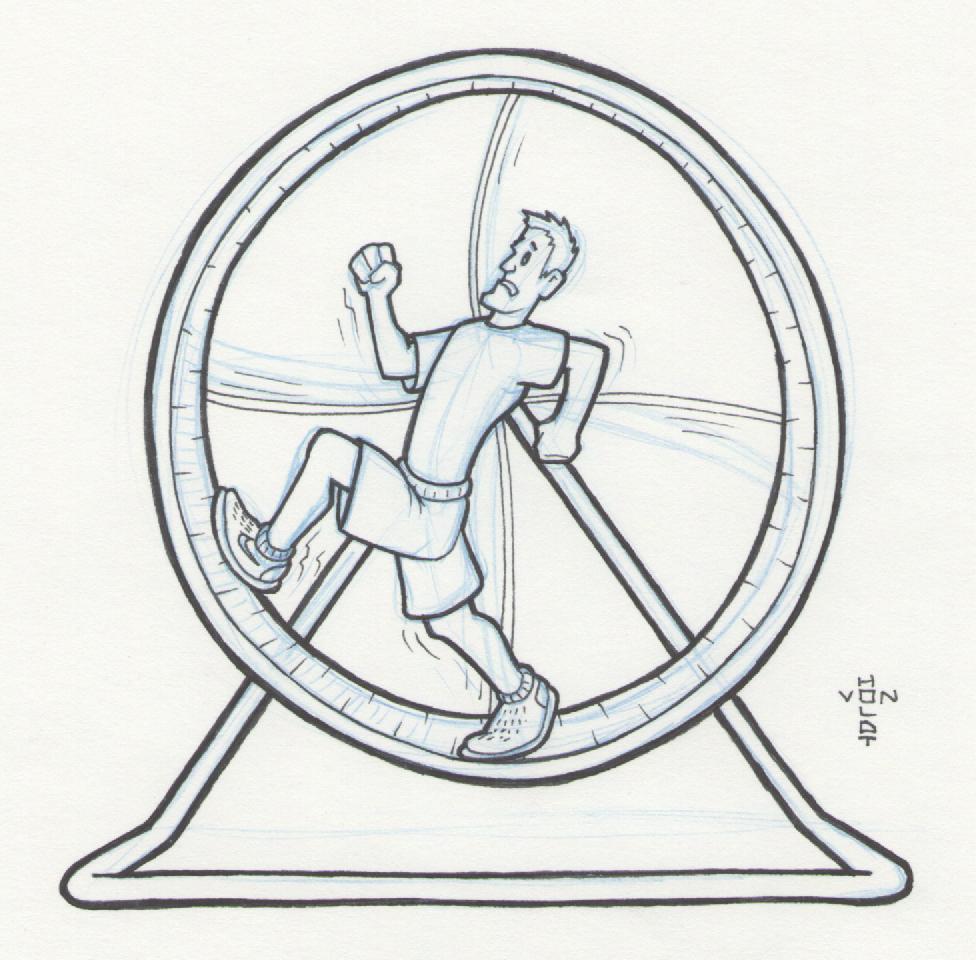
Showing posts with label Strength. Show all posts

Wednesday, October 9, 2013

Get Ready to Be Uncomfortable

Not this kind of uncomfortable...
Today, I'd like to share with you what I think is the real secret to the success Michelle and I have enjoyed in our fitness journey.  It's not about the perfect program or meal plan.  It's not some poster slogan.  It's certainly not a supplement or magic food.  It's about getting uncomfortable.  I'm not talking about pain or training to exhaustion.  It's something much simpler and more fundamental than that.

Let me see if I can explain.

Last week, I asked Michelle what she wanted for her birthday (she's turning schfurtny-trax, for those who are curious.  C'mon, you know the name of our blog...).  Almost without hesitation, she told me, "I want to learn the Olympic lifts."  First of all - I confess that I fell in love with her all over again at that moment.  Here is a woman I've known for 23 years and she still surprises me.  

We've been focusing on powerlifting for the last year and she's made tremendous progress.  She's flat impressive to watch at the gym.  She's really worked hard at focusing on the things she had the most room to improve on and drive through.  Who am I to deny her this one simple wish?  Besides - you try stopping her.  

So I made some calls and got a referral for a truly remarkable coach.  I'll leave out the name-dropping for the moment and save that for a later post.  We made contact with him and, as it turned out, he was lifting in a competitive meet at his home gym that weekend.  This was the best of all worlds.   We went to the meet and watched competitors of all sizes and skill levels yank bars from the floor to their chests or straight over their heads.  To call it impressive would be an understatement.  We had a little quality time with our new coach and, after about three hours, headed back to the homestead.

It was on the drive home that things began to sink in.  "I'm a little scared of all of this," Michelle confessed to me. "Am I totally crazy?  I'm in my forties for the love of God!"  As you can imagine, a fairly animated conversation ensued.  

"What's the worst thing that could happen?" I asked her.

"Well, I could hurt myself, but that's no different than any day at the gym, is it?"  I replied that it certainly wasn't.

Becoming "Settled"
Not what I meant either...
Michelle and I have been very fortunate to have taken career paths where we were basically (and sometimes literally) put in an empty room and told "I need you to make this happen."  A comfort zone isn't a luxury we were ever granted.  As it turns out, after two decades of this, it's become a compulsion.  Neither of us is satisfied with something after we've mastered the challenge.  It seems utterly natural to seek out the next opportunity to learn and grow.  

And that's the secret!

I'm not suggesting that everyone needs to go to extreme lengths and bungee jump out of a burning airplane with a frayed rubber band.  But I do know that, most often, we create our own limitations.  Have you ever watched a child work themselves up to taste something new?  It's an ordeal!  They're so sure that it's not for them that it would be easier to get them to put their hand on a hot stove rather than take that first bite.  And then what happens?  Chomp! Either they like it or they don't.  But we celebrate, right?  "At least you tried it, little Johnny!" 

When did we lose that?  When did we stop trying new things, for fear that it would be a disaster?  We chain ourselves up with thoughts like "I've never been a good 'X'er." or "I'm too old for something crazy like 'Y'." At some point, we yield to the expectations and assumptions associated with getting older.  Forgive me, but screw that!  I'm not letting any expectation or assumption define my vitality and love for life.  And, in my humblest of humble opinions, you shouldn't either.  Don't settle!

Get uncomfortable
If you ever want to feel true satisfaction, try something you didn't think you could do.  Or, better yet, work at something you know you can't do today until you can!  But doing that means leaving your comfort zone.  If you haven't felt that "what was I thinking? I'm going to make a total fool out of myself!" sensation in a while, it's time to dust it off.

Now, mind you, maturity has its own gifts.  Among them, a sense of consequence.  You don't need to do something dangerous to find something that scares you. 

Definitely not what I had in mind!  Awkward!
There are so many benefits to getting outside your comfort zone!  One - it makes you humble; you remember that you still have something to learn.  Two - it gives you something to learn!  I'm absolutely a firm believer that life-long learning is the key to an agile mind.  Three - it brings back your sense of awe.  Let's face it; we've seen a lot of things in our lives.  It's difficult to find something that truly knocks your socks off (until you seek it out).  Four - it gives you confidence that flows over into the rest of your life.  And five - you might find a new passion in life.

So what are you waiting for?  Try something new today.  Yes you might not be as good at it as you want to be (yet).  But you might be awesome!  Either way, we celebrate, right?  At least you tried it!

Sunday, September 29, 2013

Rolling With Rhabdo - My Story

There's a lot of buzz about a Crossfit article out there this week.  It exposes a risk that, frankly, is my number one reason for refusing to ever endorse or condone it as a method for people who are out of shape to get fit: Exertion Rhabdomyoliosis (rhabdo to his friends).  But, as revealing as the article is, it left out what I belive should be the most important part of the story:  how rhabdo occurs and how you can identify it.  I mean, without that, the whole thing is just rabble-rousing for people that already have strong opinions on one side or the other.

See, I've been there.  I was hospitalized, near death, with one arm marked in marker "no needles - may need dialysis", just in case.  Today, I'm back.  Fully recovered and training hard.  But the experience has changed the way I approach training for good.  Hopefully, after reading this, you'll avoid this kind of scare, no matter what training regime you choose.

Background: "The best day of my life"
In 2008, I was selected to join a very small club: the ranks of Chief Petty Officer in the US Navy.  The Navy is big on rituals, and this is one of the biggest.  Upon selection, I, along with the rest in my cycle, were put through two months of intense training, supposedly to ensure that we had the mental and physical toughness to fill the role of a leader in this unique fraternity.  There were late-late nights, early-early mornings (even by military standards), lots of memorization and mental challenges.  And then there was the PT, laced quite liberally through all of it.  During this period, every time one of the senior Chiefs conducting the "training" asked the question: What day is it?  We all responded in unison "the best day of my life!"

Humph.

For me, I was in what you'd probably call "decent" shape.  I made my weigh-ins and passed my PT tests twice a year.  Never maxed out, but I was staunchly in the middle of the pack.  At 37 years old, I felt pretty good about that placement.  I was probably about 15-16% body fat.  This matters because most people that fall prey to rhabdo are not couch potatoes.  People who are completely unconditioned simply lack the physical capacity to push to the point of rhabdo.  

Setting the Stage for Disaster:  The Risk Factors
So I've already mentioned the first risk factor: "decent shape".  People that are prone to rhabdo are somewhat conditioned.  They also have relatively low body fat percentage (compared to the general population).  This sets your body up to hit a point where you can exert past your limits and your body lacks the stored metabolic fuel (i.e. fat) to compensate for the consumption level.

The next risk factor is environment.  Chief's training is conducted in August and September.  For me, it was in south Texas.  Heat and humidity both dramatically increase the risk for succumbing to rhabdo.  They add stress to your body during exertion and limit your ability to recover due to heat stress and dehydration.  San Antonio in August was a virtual incubator for rhabdo. 

The third block in the rhabdo virtual Jenga tower is stress, both in the active accumulation of it and the lack of ability to recover from it.  As if the training itself wasn't intense enough, I was going through a rather disasterous stage in my personal life.  Sleep just wasn't an option.  I was racking up tons of stress every day and doing nothing to recover from its effects.

And the final tipping point that brought it all down: ego. Both mine and on the part of my trainers.  I had a Navy dive master and a Fleet Marine Force Corpsman running the physical portion of the training.  These are two of the tougher professions in the Navy.  And they were merciless.  They set out to "break" each of us.  And I set out to match every challenge.  I can say I was hopelessly outmatched. 

The Tower Comes Down: The Symptoms I Missed
I've had the advantage of participating in some pretty cool training over my career.  One of the coolest things I would never ever want to repeat was the Air Force's combat survival school in Spokane, Washington (and undisclosed points well north of there).  I knew what dehydration looks like.  I knew what the symptoms of severe stress are.  But, in the moment, I glossed over a lot of things that should have set off alarm bells and sent me straight to the hospital.  

After one particuarly tough training session, I noticed that I was producing very little urine.  What I could produce was dark (we're talking almost Pepsi here) and cloudy.  I knew that was a bad sign, but I downed a gallon of water and hoped for the best.  Stupid?  Yes - but between the stress and ego components, I wasn't in a place to make a good decision about it. 

Then I started to notice the swelling.  Hands, feet, belly.  They all got progressively more puffy day by day.  Not normal?  Cause for concern?  Of course.  But I still figured it was just a temporary blip from a tough schedule.  

Finally, I noticed that I felt like I was in a mental fog.  I just could not form a straight thought in my head.  Since my whole adult life has been dedicated to problem solving as an analyst in various fields, strangely this alarmed me more than the physical symptoms.  It was now five days since the training session that had pushed me over the edge (with some additional sessions in between).  I drove myself to the hospital.  

The Diagnosis: Reality bites
Military emergency rooms are notoriously slow.  I checked in at the front desk and settled in for what I was sure would be a four-hour wait to speak to an actual doctor.  Fifteen minutes later, I was triaged by a corpsman.  I explained my symptoms, saying, "I'm not sure I should even be here, but I just don't feel right and I can't shake it."  After taking my vitals, the corpsman got very quiet.  My blood pressure was through the roof (symptom five).  I was admitted and hooked to an EKG in ten minutes.  

They started running diagnostics.  Thirty minutes later, the doctor came in.  "You're in some pretty bad renal failure.  We're going to admit you and see if we need to put you on dialysis."  For the first time in my life, I was truly afraid of dying.  

I spent the next week in the hospital.  I was put on heavy diuretics to flush my kidneys out.  My creatinine levels were checked constantly.  And my diet was regimented to put absolutely no strain on my kidneys through digestion.  No dairy, no sodium, and very little of anything else.  I was put on blood thinners and blood pressure meds to prevent any further cascade effects.  Thanks to showing up at the very end of my possible window and a very good nephrologist, I managed to avoid dialysis.  A week later, I was well enough to leave the hospital.  But I was in for a very long recovery.  Over the next six months, I very gradually returned to a normal diet, began light exercise, and finally weened myself off of the blood pressure meds as my kidney function returned.  I was lucky enough to get back to 100% function.  Not everyone is. 

What Happened to Me?
My nephrologist spent a good deal of time speaking with me.  In that critical training session, I hit the point where my exertion put such demands on my body that my muscle tissue started breaking down in heavy quantities (catabolism in the extreme).  The protein in my blood stream put such a strain on my kidneys that they simply stopped doing their job.  We're not talking nicely digested amino acids from eating meat.  We're talking about a direct injection of muscle protein straight into the blood stream.  I made it worse every day by continuing in the routine and conditions that got me where I was.

I hit that point because I pushed too hard in conditions that were too difficult for the body to overcome and I had no reserves to draw from.  Interestingly, of all the lifestyle conditions we discussed, the doctor was most alarmed by my long-term relationship with NSAIDS (Motrin, Tylenol, et al.) as a routine pain and swelling remedy (risk factor five).  These things are nasty.  I still only take them in times of serious need when I just can't tough it out.  

Crossfit and the Bottom Line
At the end of the day, I did this to myself.  I didn't exercise the maturity and judgement to stop before things got out of hand.  But... I put my trust in the hands of an authority figure who I expected to have my best interests at heart.  Having done that, I wholly gave myself over to the "mob mentality" of the ritual and the culture of the Chief's Mess.  That didn't work out so well.  Since that time, I can tell you that injury and relaps are always a factor that goes into my selection of training methods and intensities.  I don't leave that decision to anybody else. 

I'm not going to say that "all Crossfit is bad".  That is far too broad a brush.  But there is a real risk involved here, given the type and intensity of training involved.  If you have a personal trainer and you haven't discussed where you both stand, you should. 

Crossfit trainers (and any personal trainer, for that manner) take on a heavy degree of accountability when they take on clients.  But, without strong dialog between trainer and client, they can't be aware of the compounding set of risk factors that may be piling up on you.  That gets harder in a group "one size fits all" environment.  Add in a cultish culture of "push til you drop" and the chance that your trainer is keeping a watchful eye on you drops to an alarming low.  Since the vast majority of personal trainers are under-educated on the causes and symptoms of conditions like rhabdo, you simply can't expect them to have your back.  

Thursday, September 12, 2013

Five Secrets to Smashing a Plateau

Whether your goal is to lose weight, gain strength, or improve athletic performance, we all fear the dreaded plateau.  A plateau is that point when your conditioning, your training, and your nutrition reach equilibrium and you stop seeing progress.  In order to kick-start your performance, try applying some or all of these simple ideas.

1. Examine your program


Look at your nutrition and training plan.  Do you actually have a nutrition and training plan?  Or are you following a general mish-mash combination of "eat less; move more". Even if you have a "great" program, it's not so great if it's not designed for the specific results you are seeking.  Let me say that again: if it's not delivering the results you need, then it's not a good program (for you). If you've been on the same plan for a while (six months or more) and are no longer seeing progress, well - variety is the spice of life.  

2. Examine your dedication
Even the perfect program doesn't get you results if you aren't following it.  This is akin to sleeping on your history book to study for the test.  Haphazard adherence will deliver haphazard results.  If time is the issue, find a program that works better with your schedule.  There are lots of ways to make your meal planning and training time more efficient.  Just remember: if nothing changes, nothing changes. 

3. Re-think "progress"
Be better than yesterday.
Probably the most frustrating thing for people that have just graduated from the "newbie" stage of fitness is that progress slows down dramatically.  Or so it seems.  This is especially true if you're only looking at one measure for success, such as scale weight.  As your body composition changes, lots of things are happening.  You may be losing fat, you may be gaining muscle, your body may be making a lot of changes on the inside that don't translate into a pound a week just now.  

Now I'm not saying that you rationalize away a lack of progress by saying "maybe it's muscle".  If you don't know it's muscle, then you need to figure it out.  Find out how to calculate your body fat percentage.  Or - even better - find elements you can measure and improve on every day.  Olympic clocks measure time in hundredths of seconds.  The smallest advantage can be the difference between a gold medal and a "well you really tried".  Tiny factors and minuscule improvements add up.  Whatever measures you choose, find something that you can make better than yesterday.  

4. Re-boot
If your program is on track and if you are following the program religiously and if you are looking at all aspects of your progress and still not seeing results, consider backing off for a short period.  Get rest, get hydrated, relax, and let your body recover for a few days.  Your body needs down time to do the critical work of adaptation.  A deload or break should be programmed in every four to six months, depending on your routine. This applies equally well to caloric restriction (diet) programs as well.  "Refeeds" have worked for many people on their weight loss journey.  

5. Push yourself
The bottom line here is that, as you condition, the same activities may not deliver results anymore because they just aren't challenging enough.  Just because your program says "perform five sets of five reps" doesn't mean you're finished.  There are no rep police.  You won't get a ticket for exceeding your awesomeness limit.  How do you know how much you're capable of if you clock out just because the set is over.  If you have more left in you, grind out another one.  Sprint to the finish!  You get the idea.  


Regardless of whether your particular plateau is related to performance in your sport or a weight loss journey, the methods you use to break through are the same.  Be honest with yourself, be skeptical, and be purposeful.  These tips may seem simple, but, at the end of the day, it is simple.  It's not easy, but it's simple.  

Thursday, September 5, 2013

Why We Train: Moving Day

Those of you that follow Michelle and I in other social forums know already that we recently moved across the country.  Despite a couple of hiccups, I'm happy to report that we are happily settled in to our new digs and beginning to explore the possibilities that Arizona offers.  (Although, yes - it's REALLY hot here in August).

As the flurry of activity subsides, we've been talking about the experience.


The question: how do you stay motivated to keep training for the long run?
We hear this one a lot.  People get frustrated.  They don't see progress.  They don't have a concrete goal in their head about what their time at the gym should do for them in the long run.  We've often used the phrase that we're training for life.  And let me tell you, the past month has thrown an awful lot of life our way.  So I thought it would be interesting to share with you how we feel our training has come into play during that time. Do any of them surprise you?


Motivator 1: Keeping our Sanity
Studies show that moving is one of the most stressful life events a person can experience.  While I will immediately give credit to Michelle's supreme planning skills in making this the least painful move I have ever experienced (and that's a large sampling, folks), the ability to keep at least one point of consistency in our lives was a huge help.  We did some serious flexing in our schedule, but putting on the gym clothes and throwing around heavy things for an hour was a way of taking back control of our time and burning off some of that nervous energy.

Motivator 2: Lifting All the Things
Michelle and I lived in Minnesota together for two years.  And I can tell you, those flower pots in the garage were a lot heavier when we moved in than they were last month.  I'm not sure how that happens exactly.  Maybe our flower pots have been getting ripped on Hydroxycut.  (I'll leave it to you to decide.)  We were able to self-pack and unpack 90% of our household, which saved us a ton on moving expenses.

Motivator 3: On the Road
I don't know about you, but I've done a lot of long road trips of over 1,000 miles.  It beats you down.  Back pain, arms tingling, hands sore.  Not to mention the lovely elderly penguin walk you rock after getting out of the car.  This drive was over 1,800 miles and, I'm telling you, I didn't get any of the usual side-effects road trips usually throw at me.  Granted, I was ready to get the heck out of the car at the end, but we hit the ground running upon arrival.

Motivator 4: Adaptation and Execution
Okay - Phoenix is HOT.  I mean, it's called the Valley of the Sun for a reason.  And, in August, it's the hottest kind of hot you can imagine.  And Minnesota  - well - isn't.  It was no small change to acclimate to the desert environment.  And we had a week from the time we moved in to have everything up and running before I had to be back into the work groove.  Landscaping, painting, arranging furniture, you name it, we did it.  Heck, we even helped Michelle's niece move into her new house when we were done with ours.  Having a body that is strong with healthy energy levels was key to us pulling this off.


Motivator 5: Keeping our Figures
We see and hear from a lot of others on their weight loss journey who complain about weight gain after a vacation or a stressful life event.  It's such a common theme, in fact, that we basically assumed it was a given that we would put on a couple pounds.  I mean, we cut our training way back, were stuck in a car for three days, and were subject to whatever food was available at the exit where we needed gas.  It only made sense.

When we weighed in, however, we found that we both lost a couple pounds.  How?  Credit an optimized metabolism combined with a lifestyle that has made us completely re-think what "food" is.  We did lose some ground in the amount of weight we could push in the gym, but a couple of weeks of getting back into our program put us back on track.

I hope I'm getting the point across here.  Life Happens!  If you find yourself wondering why you keep getting out of bed early or stopping after work to hit the gym, then think about the events coming up (anticipated or not) you're going to weather.  Even if it's changing a flat on the side of the road, these kinds of things go so much better when you feel strong.  They don't knock you down so much and you get back up a lot faster.  What will it take for you to be better prepared for that next big change? 

So - why train?  Because... you never know. 

Tuesday, August 13, 2013

Obesity's Perfect Storm

There's something going on in the Western World.  And, despite so much attention being focused on it, it's still getting worse.  The average westerner has lost touch with the innate ability to feed and, thereby, care for ourselves.  People are getting heavier and sicker by the day.  We're more educated, have a higher living standard, and medical science is more advanced than ever before.  How are we not getting the message?

It must be something bigger.


I'm not a conspiracy theorist.  But I do believe in complexity.  And the more I learn, the more I see a "perfect storm" of factors that have come together to, quite literally, shape our society.  To peel it all back, let's take each factor one at a time.

Storm front #1: Flawed Science
It really all starts here.  Whether you agree with his "carbs are the real problem" stance or not, in his book, Good Calories, Bad Calories, Gary Taubes paints a fairly dismal picture of the evolution of medical science with respect to weight and health management.  The foundational focuses are decades old and were based on the limitations of what was known and what could be measured at the time.  These foundations have endured over time and, like a crooked wall, veer ever farther from the original premise.

Scientific studies can do as much harm as good.  This is no critique (necessarily) of the researchers themselves, but more of the instant-gratification, dumb-it-down media to immediately take things out of context and beyond the scope of the study.

These days, the focus is on "curing" obesity.  It was even recently designated a disease.  Open the door for "there's a pill for everything" medicine.  Family practitioners are not up to speed on nutritional science breatkthroughs, and are also less likely to explore lifestyle treatment, like meaningful physical exercise.  The lifestyle mantras are quoted chapter and verse by doctors across the world: get 30 minutes of cardio, 2-3 times a week and eat less fat.  But there is little expectation that patients will follow this advice, so very little emphasis is put on the importance of lifestyle and health.

Specialization also takes a toll here.  Diabetologists and endocrinologists are on the front lines of the impacts of obesity.  But those specialists come into the picture after things are well out of control, and "downward" communication to your family doctor isn't happening the way it should.  Instead, the entire focus has been put on calories in vs calories out, rather than on how to nourish and power our bodies.

Storm front #2: "Big Fitness"
The fitness industry, from big box gyms to "as seen on TV" wonder DVDs and gadgets, to the purveyors of miracle supplements and shakes, is a mult-billion dollar industry.  And its customer base is growing.  There is no incentive for the fitness industry to actually get you into shape.  In fact, they'd rather make you dependent on their products and keep you coming back as a return customer.   If you buy a gym membership and never go, the gym still gets your money and the equipment you would be using remains vacant for yet another member.  It's a win/win for the fitness center.  And nothing you buy from TV is ever going to deliver the results promised.  They even tell you that, right on the screen: "results not typical".

Storm front #3: "Lifestyle Marketing"
Can I have a side of Diabetes with that?
I'm in the marketing industry myself.  Everybody is looking for that fundamental emotional connection to make with their customer.  Lifestyle marketing is when you tie your product to a way of life, a feeling of prosperity, happiness, and success.  The tactics are incredibly successful.  Now think about the last restaurant commercial you saw.  Was it really about the food?  Or were there images of attractive people having a great time while eating food?  If you want to have a good time with friends, what is the first thing that comes to mind?  A meal out somewhere?  Where did that come from?

Now think about the advertising for "convenience foods" that pepper the television.  What are the underlying messages there?  Cooking is hard and you don't have time.  Your family will love you for serving this dish.  Plus: hey! added fiber / reduced fat / naturally sweetened - you name it.  Bottom line: this is better than what you could possibly pull off on your own.  Nonsense, I know.  But we, as a society, are completely in the thrall of the convenience food message.  

Storm front #4: "Addictive Flavors"
On the first three points, we are talking about information that is widely available and completely up to the reader to make an informed decision.  Let the buyer beware, right?  But, when it comes to addictive flavors, this is the one topic where I will point a finger at a malignant source.  

Food companies consult with flavor labs to create the perfect balance between a distinctive flavor and a very limited finish.  When the food is in your mouth, the texture and flavor are extremely pleasing, but, in these engineered flavors, the moment you swallow, you need a "boost" to get the flavor back.  It literally keeps you coming back for more.  

We haven't been eating clean for that long: just over a year.  I still remember foods that I loved.  They were my go-tos week after week.  We recently drove across the country and hit some pretty austere territory in the process.  Our choices were limited.  I literally had McDonalds for the first time in 13 months.  It tasted like - nothing.  Nothing at all.  Place after place we stopped, it was the same story.  Safe to say, we were sort of stunned.  When you're used to real food.  The stuff you used to think of as craveable is just a pale shadow of flavor.  And that's the way they design it.  

Storm front #5: "Pop Media"
Have you noticed that when you flip through five different news broadcasts, they're all on the same stories?  That's because they all take their information off the same news wire.  We are obsessed with the sound bite and the news feeds us exactly what we want.  When a study that took five years to conduct and comes with four hundred pages of findings is reduced to a two-minute blurb read by a talking head from a teleprompter, it's fairly safe to say that you aren't getting the nuances.  

Take the recent story on Omega-3 fatty acids.  The study took participants who had prostate cancer and examined their blood chemistry to see if there were any trends.  They found that some of these participants had elevated levels of Omega-3 DHA.  There was a correlation between these participants, all of whom had cancer, and blood levels of this fatty acid.  Of course, people at risk for prostate cancer (men over 50) have been bombarded with messages about supplements that will reduce their risk or the severity of the cancer.  Did they have elevated levels because they were fighting cancer, or was the cancer a result of the Omega-3?  Or... was some other element of body chemistry out of whack that contributed to both the cancer and the blood lipid levels?  The study confessed not to know.  But the news story said "Taking fish oil is associated with an increased risk of prostate cancer."  Period.  

Beyond the news, you run into an endless stream of "talk" shows that are, at best, the blind leading the blind, and at worst, a serious conflict of interest.  People who profit from the endorsement of a product on their forum should be regarded with skepticism, especially when it comes to your health.

Storm front #6: "Urban Myths"
The Internet is a fabulous thing, isn't it?  I mean, you're enjoying our fabulous content right now thanks to the "information superhighway".  But the Internet is a peculiar paradox.  On one hand, it has nutured our craving for instant gratification.  There is always something new to grab your attention.  On the other, it is a vast repository of things that just won't die.  In my military life, when you got a new regulation or new set of orders, they would always tell you that the previous version was obsolete and you should get rid of it.  That was nice.  It was clean and simple.  The new guidance is the only guidance.  

Not so in our modern world.  Everything gets mixed up.  This will save you, that will kill you.  Then tomorrow the whole thing is reversed.  The result is that people hold on to whatever piece of information struck them first or resonated the most, with a healthy dose of skepticism for anything that conflicts with what they perceive to be the truth.  And, with the Internet, they can perpetuate it through a host of different channels, continually re-muddying the waters.  

People mean well.  They believe that their information is the right information.  But there is very little to help you, the reader, from separating established fact from outdated convention from plain ol' poppycock.  

Superstorm: Obesity
By themselves, none of these "storm fronts" would do much damage.  But the way they've coalesced into a combined power, it has colored our perception in a profound way.  Look at how these look when they're strung together into one set of attitudes about food and fitness:

     "I'm overweight, and I know I need cardio exercise three times a week to burn fat, plus I have to watch my fats and cholesterol.  Fiber's great though, so I should eat more grain.  Plus, I drink green tea every day, since it's a fat-burner.  I have a membership at a great gym; they have all these cool classes and tons of treadmills and elliptical machines, plus I bought that "Turbo Jam" DVD, so I can tone and shape my muscles.  It really makes me sweat."  

     "I eat pretty healthy; I only buy low-fat and low-calorie foods. Except on weekends, because that's when I go out with my friends.  Dinner, drinks and dessert are such a great way to unwind and I deserve a little reward.  I'll just work out twice as long on Monday.  When I'm hungry, I usually have an extra bowl of Special K, because it's heart healthy and "they" say the studies show women who eat this weigh less.  Besides, it's delicious! I could eat a whole box of that stuff every day."  

     "I'm not sure why I'm not losing weight.  I don't eat eggs, cheese, or meat hardly ever; I only drink diet soda now, and I've been taking Hydroxycut for months.  I only eat 1200 calories a day (when I don't cheat).  I'm just so tired all the time.  I have no time or energy to go to the gym, let alone cook a lot of crazy food.  I feel bad, because I've paid for the membership, but I'll get back in there soon.  Guess I'll microwave dinner; it's Healthy Choice at least."

Do these sound like anybody you know?  Do you see the subtle influences of the six "storm fronts" across them all?  

How about this one?

     "I love food!  It seems like I'm eating all the time.  Steak, cheese, and full-fat Caesar dressing?  Bring It!  I can't remember the last time I had a bowl of cereal.  I have a vague idea of how many calories I'm eating, but I don't count and don't really care.  I  never jog or hit the elliptical.  The best thing is all the great flavors I get to eat: Mexican, Greek, Chinese, and Italian.  Besides, I save a ton of money by eating at home."

This person is obviously unconcerned about his or her health.  A walking time-bomb, right?  Well, the truth is, this is a declaration that Michelle and I have both made more than once.  In fact, though it is only part of the story, it is a big part of our attitude toward nutrition now.  It flies in the face of everything you know about eating healthy, right?  How could we possibly lose weight with such a bizarre approach to nutrition?  

I'll repeat what I said at the beginning: something is wrong - something bigger than "eat less, move more".  We believe that we have found a winning approach to nutrition and fitness.  I won't say "right" because your goals may be different.  But if you want to lose fat, be stronger, have more energy, and feel great about how you feel and look, then you've come to the right place.  You've got to shed the conventional wisdom, choose a nutrition plan (not a diet) and a training plan (not exercise) that will deliver the results you want.  

Monday, July 29, 2013

Genes, Boxes and a Milestone

Today's post is a bit of a blender.  There's a lot going on here at 40SomethingFitness and we wanted to keep our readers up to speed with the very latest.

First, a celebration!  Since opening our virtual doors in January, we are just about to hit the 10,000 views milestone! We can't thank all of you enough for your support!  So, take a little bow.  We'll wait.

Done?  Okay, good.  Moving on.


C'mon, you know you're singing it!

Housekeeping: We're also in the throes of a move from Minnesota to Arizona (quite a switch, I know), so we may be a little scarce over the next week or two, both here and on our social forums.  Fear not, we will be back with a fresh set of ideas to educate, inform, and inspire.  

Artists rendering of our road trip - actual results may vary.

Contest: Faaabulous Prizes!
I'd also like to take a moment to pitch the Google+ Fitness and Nutrition community.  I know people have their feelings about G+, but this community is growing fast and we're working hard to keep the feed high quality and un-spammy.  We're also sponsoring a writing contest on the community.  Submit a short article and your post could be featured on all of the forums and blogs of our moderators.  How's that for bragging rights?  Here are the details:

Challenge Subject:  Why Fitness and Nutrition is Important for Good Health
Post Criteria:  100 -150 words in length

Reference Google+ and  *Fitness & Nutrition Community* within the text of your post
 

How To Submit Your Post:
1. Join Fitness & Nutrition Community - http://goo.gl/PafDf
2. Post your submission either linking to your blog or directly to G+ under the#FNContest  Category.
3. Add #fncontest  to identify your post for the contest.
4. Posts will be accepted from July22 through August 23.

Prize:
The winning post will be shared out through our extensive Fitness and Health Network both within and outside of Google Plus.
Your Logo & Link posted on the +DRS Health Blog sight and their 21 Landing Page Network.
You and your post will be featured in a Fitness & Nutrition Community HOA which will be premiered at FitnessHOA.com and HealthcareHOA.com .  DRS Health will also give the winner a 30 day supply of H3 Rapid Recovery.
Runner Up - will receive a 15 day supply of H3 Rapid Recovery. 


Finally, we're excited to announce a partnership with GoFitty.com as featured authors in their news section (and other forums currently in super-secret negotiations).  We'll be regularly publishing original content there to add to their growing network of contributors.  So please check them out.

Which brings us to this week's post:

Are your genes making you fat?

In fact, our latest offering is featured on GoFitty.  A reader shared an article with us from Science Daily that published the results of a study which seemed to indicate that people were able to shut off their fat genes through exercise.  Naturally, that raised a whole line of conversation about how much of an impact genetics have on body composition.  We combed through the studies and publications and learned quite a bit.  Check out our full story.

Tuesday, July 16, 2013

Don't waste your time with exercise


That's right, I said it.  And I'm not sorry.  But before you gather up the pitchforks and torches or make a call to "Shady Acres" to see if they have an opening for me, hear me out first.  

Recently, a friend shared this story with us:

He was at the gym, when an "older guy" came up and asked if he could work in.  The man was chatty, said he wished we could get some younger guys to do the lifting for us. Our friend told him that's why he was lifting, to be younger again.

The gentleman said, "I've been lifting for 50 years; started when I was 12. My mother said it would get easier. She lied. It just hurts more. It's not really possible to get in shape."

I hate to think how many hours of his life this man frittered away, all the while utterly missing the point.  Those are hours he will never get back.  And he'll never see the rewards that were right there for the taking either.  

Another conversation Michelle had with a young novice lifter:
The young woman was frustrated.  She hasn't been losing any weight and she hasn't seen any improvments in strength either.  Michelle looked into her workout log and saw that she has been doing the same weight for the same number of reps for as far as she cared to scroll back.  Except for one day.  On that day, she increased the weight a couple of pounds.  Her comments were, "this is definitely harder. Help!"  After that, she went right back down again.  

Michelle explained to her that she had to push herself.  That the only way she would grow or see improvment was to increase the weights.  The young woman said she couldn't do any heavier weights; she only "ended up gritting her teeth and pulling something". 

That conversation ended with Michelle just shaking her head.

By now, I'm sure you're seeing my point.  But I'll spell it out anyway.

If you don't have a goal, you're wasting time at the gym.
If you don't have a program that is designed to reach your goal, you're wasting time at the gym.
If you aren't pushing yourself when you're at the gym, making every day a little better than the last, you're wasting time at the gym. 
If you go home and throw it all away with poor nutrition, you're wasting time at the gym.  

You pay good money for your membership.  You put in good, valuable hours of your life when you go.  For most of us, this isn't spare time or spare change you couldn't find anything else to do with.  It's a squeeze.  So, why would you commit precious time and money to activity with no purpose and no results? 

"But I just want to be generally fit and healthy; what's wrong with that?"

Here's a secret: there is no such thing as a maintenance work out.  Let that sink in for a moment.  

There's your problem right there!
Your body adapts very quickly in response to exercise.  Your ability to perform - strength, endurance, power - are measurably improved after one session.  Go back a day or two later and you'll be able to do a little more than before.  It may not be much.  Hell, it may not feel like anything, but it's a fact.  

A "maintenance" routine is truly nothing more than getting stronger, faster, better, and then, without progression, deconditioning until the same routine becomes challenging again.  This is akin to having an oil leak in your car and never fixing it, just continually adding a quart.

Five things you can do to make your workouts count.
1.  Be present.  We've written before about the value of getting your head in the game, not just in the gym, but in anything that matters to you.  It seems obvious, but in our multitasking world, I think most of us are accustomed to dividing our attention out of habit. 

2.  Have a goal.  Again, it seems obvious, and it is written about regularly, but even within your individual workouts, you should have a goal.  "Today I'm going to do one more 'X'." or "Today, I'm going to increase my speed by .5mph for the first five minutes."  

3.  Don't sell yourself short.  You are capable of more than you think.  Don't you want to find out how much more? 
Now - HE - is done!

4. Compete with yourself and keep score!  This goes along with #3, but bears calling out.  If you are doing the same weight for the same reps, or hitting the same speed on the treadmill for the same distance, you are leaving your gains on the table.  Not to mention, as you condition, you burn fewer calories doing the same workout.  A five-rep set isn't over because you hit five.  It's over when you push up your last rep with good form.  (Michelle and I call this "the world's longest rep")

5. Don't be afraid to suck.  Okay, once again, let me explain before you hit the "close window" button.  We gravitate to things we are good at.  It feels good to be good at something.  But, in the gym (as with many places in life), the places where we feel least competent are the places we can grow the fastest.  And there's only one way to improve a weakness: challenge it.  Again and again.  Make your weakness your new strength.  

Wrapping up, I'd like to make sure we end on a positive note.  You've already committed your time and your money to getting to the gym.  That's a huge step.  Make those hours count.  Think about how you will remember those hours years from now.  You're welcome. 

Thursday, June 13, 2013

How the Calorie Ruined Nutrition

Okay - that's it - I've had all I can take...

I know we are going to start a storm here, but, day in and day out, we keep seeing the same mythology and misunderstanding being perpetuated around the Internet, the water cooler, and forums across the web.  It's time to try and put it to rest.

The dietary Calorie, a brief history:


The Calorie, in its modern definition, came from  roots in mechanical physics at the time that the steamboat and the steam engine locomotive were the height of technology.  It was, as today, a measure of heat energy to quantify the effects of fuel on a thermal engine.
 In the mid-1800s, this concept became adapted to food consumption, though the measurement was transformed into the more practical Kilo-Calorie (kcal).  The concept was introduced to the public by Atwater in the journal "Century" in a series of articles.  Ironically, even at this early stage, scientists acknowledged that "The potential energy represents only the fuel value of the food, and hence is only an incomplete measure of its whole nutritive value".

As a unit of energy, the calorie has long been surpassed by the joule, but the term Calorie has become so embedded in our nutritional awareness, that it has never been replaced.

The method of determining the caloric value of food is the same as it has always been: a calorimeter, which combusts the food in a laboratory and records the heat energy generated.  Which is great, if you're a pot-bellied stove.

What's wrong with the Calorie?

This obsession with food = calories = energy = balance to be maintained and manipulated is baffling.  Somewhere along the way, we forgot about the difference between energy and matter.  Energy that exists solely as energy can be found in all kinds of places: light, heat, radiation, house music... well, maybe not house music.  Matter, on the other hand, has mass and takes up physical space in the universe.  Which category do you think your chicken breast falls into?

The whole calorie theory rests its ponderous bulk on the First Law of Thermodynamics, that energy cannot be created or destroyed, only transferred or converted.  Fine and good, except that, as matter, the things we eat as food also have the laws of physics surrounding them.  As finite quantities of molecules, you can't burn them and build with the same piece.  You have to choose.  

YES, okay, the chicken breast can potentially be used as energy.  And some of it certainly will be.  But some of it, depending on your age, metabolic health, training routine, and other factors, possibly most of it will be applied to replacing worn out tissues and building new ones.  

Think of a steak.  When it is on your plate, you look at it as "X" calories per serving.  But, in the cow, it wasn't energy; it was muscle tissue.  Stored protein that did work and burned energy.  Yes, if the cow were starving, that muscle tissue would eventually be catabolized into energy to keep the cow alive.  But then the cow wouldn't have the muscle anymore.  You can't burn it and build with it.  You have to choose.

Somewhere along the way, we took a wrong turn...

Something happened in our advanced society.  Somewhere we lost the ability to think and reason for ourselves.  Worse, some pompous scientists started bashing anybody that disputed the immutable laws of physics when it came to food - completely ignoring the fact that they had skipped a chapter along the way.  I'm not a pot-bellied stove.  The stove isn't going to take any of the wood you throw in it and use it to reinforce the iron base, or replace the stovepipe molecules that have degraded in the heat.  Nope, it's just going to burn stuff.  I'm not a pot-bellied stove.
ourselves.  Grandma used to say "eat your meat and vegetables; they'll make you grow up big and strong."  We used to think of food as nutrients, as building blocks.  In short: matter.  But some knucklehead started slapping the caloric value of every piece of food on a label and we lost our minds.  Calories became everything.

If food is just a collection of calories and calories are interchangeable, then why do some people get fat and some get muscular?  Why is there any variation in body composition between two people that eat the same thing?  Why can some people lose weight on 1800 kCal a day and others feel the need to plummet to 1000?  

And it gets even more ridiculous!

Since people abandoned their own experience for the wisdom of a food label, they have gone to unbelievable lengths to create the "perfect equation" of energy balance.  From measuring calories in, to Basal Metabolic Rate, to calories burned in exercise, we have heaps of calculators and tools to show us how to strike the magical energy balance.  And none of them, no matter how complex, are right.  

Futility, Part 1 - Calories in.


Calorie counters read those labels religiously. They add them all up, weigh, measure, and portion so exactly right.  But - there is so much variation between those labels and the actual content of food, sometimes as much as 50% above or below, that, from the outset you're doomed to arrive at any meaningful number.  Add to that the variation in cooking techniques and, well, you get the idea.  

What's more (and I'm going out a scientific limb here) many of the so-called "foods" we eat in a modern society are either barely digestible at all or so refined the body sucks it up at alarming rates.  The best documented example of this is baby formula.  Scientific studies have conclusively proven that much less of the processed and artificial nutrients used to simulate breast milk are not absorbed into the body, but passed straight into the stool.  Their solution, multiply these ingredients by the inefficiency of absorption to "force" sufficient nutrient into the baby's system.  But what happens to the rest of it?  How does it impact the digestive tract?  Anybody who has changed diapers of both breast-fed and formula babies will tell you.  

Paleo practitioners, on this score, have it right.  Though the specifics of "what" are still in dispute, there is no doubt our body was constructed and equipped to digest and process certain molecules better than others.

Futility, Part 2 - Basal Metabolic Rate (BMR). 


Apparently there is an app for that...
The next piece in the calorie-counting nightmare is calculating BMR.  There are all sorts of Theory of Relativity-rivaling calculators out there that estimate your activity level, adjust for the Thermic Effect of Food, and factor in other components like age and gender.  These calculators are supposed to spit out the amount of energy you burn just existing.  

But again, every person is unique in their combination of body composition, metabolic health, hormone levels, perceived level of activity, and even the efficiency (conditioning) with which their body operates.  Conditions such as stress, fatigue, and even the weather add further variables to your actual daily energy expenditure.  

So we start with a calculator based on estimates and subjective factors, leave out individuality and variation, and yet, somehow, spit out a number that we are supposed to consider "valid".

Futility, Part 3 - Calories Out. 


C'mon, would he lie to you?
This part may be the least controversial assertion I make, but still people cling to it.  "Calories burned" calculators are models that estimate the amount of energy you converted in your body through oxygen consumption.  Oxygen consumption is estimated by measuring your heart rate.  Most calculators include a body weight factor and some an age factor as well.  These factors are supposed to increase or decrease the base number built into the heart rate model.  

Once again, these factors entirely leave out individuality.  Conditioning, training style, and body composition all drastically effect the level of effort you put forth in any activity.  Furthermore, your body is the ultimate master of efficiency and adaptation.  That means, as you improve your conditioning in a specific activity, you will expend less energy as you continue to perform it over time.  Yet the calculator will read out the same number again and again.  

And no calculator effectively measures the expenditure of energy through anaerobic activity, such as lifting weights.  Yet every single contraction of a muscle consumes sugar, generates heat, and stimulates hormonal reactions that stimulate energy-burning growth.  And, as with aerobic activity, our body's become more efficient at performing the same workload over time, so you burn less energy each time you repeat the same activity at the same load.  

So, once again, we start with estimates, toss in generic factors, and leave out the actuals, while completely ignoring an entire class of activity.

Futility, a recap. 


So - you cannot count on the precision of the calories you're taking in, you have little hope of producing a realistic number of your BMR, and calorie monitors for exercise are next to worthless.  So why are you still doing it?

Why is the Calorie still around?

Calorie zombies? We may be onto something...
Here's the deal.  The Calorie is a well-established scientific measure, defended by the medical and scientific community for over 150 years.  And there is a very strong statistical relationship (in real food) between caloric content and nutritional density.  So strong, in fact, that at times, it's truly difficult to tell the difference.  No matter how strong the relationship is, you simply can't get around the fact that this is correlation and not causality.  

Note: It is precisely because of this strong correlation that calorie counting can prove useful to practitioners who understand and adjust for all the variability and use the relationship to achieve weight loss.  

But, in the age of ultra-processed ingredients, we have stripped away nutrition, leaving only the energy (in refined carbohydrates) behind.  To counter this, we stripped away even more of the original ingredients (like fat) and replaced them with lower-calorie substitutes like sugars and gluten.  This has created a bizarre imbalance in our perception of healthy food.  

But food isn't just energy.  And you are not a pot-bellied stove. You need to rebuild and replace your body every single day with amino acids and fatty acids.  You need to fuel your activity with glucose from quality carbohydrates.  You need to put things into your body that it was designed and equipped to consume to perform these functions.  Nutrition is about incorporating the right amounts of the right components to continue these activities.  Grams of protein, grams of fat, grams of carbohydrate, all with the essential vitamins and minerals they provide.  Anything else is malnutrition, pure and simple.  

Now, eat your meat and vegetables so you can grow up big and strong!

Tuesday, May 21, 2013

Guest Post: Three Ghosts, Four Injuries, Five Adaptations (Part 1)


One of the unexpected benefits of our fitness journey has been all of the incredible people we have gotten to know along the way. Doctors, nutritionists, and trainers have all shared their knowledge and support. But the most inspirational, by far, have been fellow "lay fitness" people that have come even farther and made even greater transformations than we have.

One of our favorites is, David, a man who dubs himself "Watchnerd" on Fitocracy. David lives in

the San Francisco Bay Area, works for a software company, did some sports in high school and college, was pretty sedentary in his 30s, and decided to get serious about his health again in his 40's. He's also one of the pithiest writers I've had the pleasure of reading in some time. Today, David shares the first part of the story of his own transformation in a series I know you're going to find both entertaining and inspiring.

"NEW RULE #9 • Everyone is injured. But not every injury hurts." 
Lou Schuler, "The New Rules of Lifting for Life." 

Prelude:

DOCTOR Z: "So you went to the emergency room on Thursday? Tell me what happened."
ME: "Shall I give the whole narrative?"
DOCTOR Z: "Yes please."

ME: "I injured myself on Saturday. I was deadlifting and --"
DOCTOR Z: "Wait, what? You were what?"
ME: "Deadlifting, a weightlifting exercise you do with a barbell, starting on the floor. Looks like this." [show motion]

DOCTOR Z: "How much were you lifting?"
ME: "135 lbs"
DOCTOR Z: "That sounds like a lot!"
ME: "It's not, really. Not among people who lift. You could probably do it with some practice."

DOCTOR Z: "So what happened?"

ME: "I was generally tired that day and had just done of bunch of exercises before the deadlift. It was last on my list. I got sloppy, started using bad form. Lifted ugly. And strained or pulled something. My initial assessment based on my symptoms was strained hip flexors on my left side. It hurts when I go through the act of standing up from a chair, but not once standing, or sitting, or lying down. It was pretty excruciating up through Monday, but it's getting better now."

DOCTOR Z: "But you didn't go to ER right away, you waited until Thursday. Why?"

ME: "After I used the toilet on Thursday, I had pretty severe pain in the affected area, but also back pain and tingling and numbness in my extremities. It was enough to make me concerned that my initial self-diagnosis was wrong and that I might have a hernia, instead. So I went to the ER."

DOCTOR Z: "Says here the ER doc checked you for hernia, didn't find any symptoms. Suspects strained abdominals or hip flexors lead to muscle spasm or splinting in the lumbar region, which might have caused tingling extremities."

ME: "Yes, although I may have been leading the witness for the last bit."

DOCTOR Z: "So, um….what would you like me to do? Would you like me to also check you for a hernia?"

ME: "I guess if you want to. But I don't think it's necessary at this point."

DOCTOR Z: "Well, keep an eye on it, let me know if the symptoms worsen, and, you know, take it easy..."

ME: "Thanks, will do…."


And that's when I knew: the process of improving my health, renovating my middle-aged body, buttressing the weak spots, strengthening the foundations, and patching the holes would be pretty much 
          All...
                  On...
                           Me.
- - - - 

It was an epiphany to realize that I was going to have to take on the primary duty of navigating my way through the health issues associated with tackling a serious fitness routine in my 40's. But it really shouldn't have been.

I should have known I didn't fall into any pre-existing medical practice bucket. I'm not a child, so don't need a pediatrician. I'm not yet truly old, so don't need a geriatric specialist. I don't have (thank heavens) a serious condition that would require an oncologist or cardiologist. I don't have diabetes and, thankfully due to diet and exercise, have managed to avoid taking medications for blood pressure or cholesterol.

I didn't fall into one of the buckets that would allow me to say: "I'm sick. Give me a pill or a surgery to fix it." The kind of categorization that our modern medical system is geared towards.

So I had a drink with a college friend, now a doctor. But not MY doctor.

Soft Tissues:

ME: "...so, that's the ER story."
DOCTOR Y: "So that's your third injury in 3 months, right?"
ME: "Well, yeah, but --"
DOCTOR Y: "You need to recognize that you're 'An Old' now."

ME: "What's that supposed to mean? I'm just supposed to throw in the towel and get decrepit?"

DOCTOR Y: "Just accept your limits. Don't push the boundaries and you won't get hurt. You're not 20 any more. You should, you know, act your age."

ME: "Did you hear what you just said? I'm just supposed to give in to creeping atrophy?"

DOCTOR Y: "No, you should definitely be active, we all know the blahblah minutes of daily exercise that the AMA says, et cetera. But you don't have to be THAT active. Just --"

ME: "It's too late, anyway. I'm already doing barbell squats. You're not going to talk me out of it. I use the power rack at my gym more than the 20-somethings. I love it."

DOCTOR Y: "Damn…I uh get winded just doing body weight squats. Heaving my daughter around leaves me winded. I haven't even worn a sports bra since I had a kid."

ME: "Huh, really? You used to be pretty fit."

DOCTOR Y: "Hey, you have a kid, you get married, you -- wait, this is supposed to be about you, not me!"

ME: "Maybe it's really about both of us, doc." [smile smile]

DOCTOR Y: "Ok, look, maybe I have sample selection bias. I just see so many torn labrums and ripped ACLs, and half of them are from guys your age who think that now that erectile drugs can give them the rigidity of a teenager with the staying power of mature guy, that they can just wake up and go Rambo at gym. It's not that simple."

ME: "Was your sample selection bias comment referring to the torn labrums or the erectile drugs?"

DOCTOR Y: "Hush, you! Look, you're not that old yet. You've probably regained strength quickly and your cardio is --"

ME: "Surpassed. I'm stronger now than I was in my 20's. Or at least I'm lifting heavier weights."

DOCTOR Y: "Exactly. And your cardio improved probably even quicker than that. But your joints and soft tissues will lag. And by lag I mean severely lag. Like months behind."

ME: "What do you mean?"

DOCTOR Y: "Think about middle aged athletes. They almost never retire because they've lost skill, strength, or endurance. It's almost always injuries, and often those are joints injuries. And these are among guys who are active for a living. They've got pretty beefed up cartilaginous tissues, so it's usually something major like a tendon or a ligament. In a way, you're lucky."

ME: "How so?"

DOCTOR Y: "Well, no offense, but you're not a pro athlete. Before you ever get to the point of blowing a ligament, you're far more likely to succumb to repetitive strain injuries before you even get to that point."

Which brings us to…

GHOST 1: Osgood–Schlatter disease

Ghosts don’t stay buried. They like to haunt you. Surprise you and scare you.

If you’re like me, you had some physical issues in your (reasonably) athletic youth. Issues that went away when you stopped being so active. Issues that disappeared when you stopped pushing your body’s limits.

You thought you outgrew them. After all, you hadn’t had symptoms in decades. But they’re still there, lurking in the background, waiting to pop out and get you. You know - like that monster-in-the-tv in “The Ring”.

Early teens through high school, I participated in a number of running sports, including soccer, cross country, and middle-distance track (400m & 800m). At the time, I developed Osgood-Schlatter disease, a fairly common knee ailment among teens. According to Wikipedia:

“Osgood–Schlatter disease generally occurs in boys and girls aged 9–16[2] coinciding with periods of growth spurts….symptoms usually resolve with treatment but may recur for 12–24 months before complete resolution at skeletal maturity”

I hadn’t had knee problems in decades. So when I decided to get active again, I did so with gusto.

My instrument of choice was the elliptical trainer. The latest studies seemed to indicate that I needed to get 45-60 minutes of “steady state cardio” in a day if I wanted to get real improvement, so that’s what I did. Every day. 6-7 days a week.

[I won’t get into why this approach to cardio is wrong-headed just now, but it is common consensus.]

And as I got into better shape, I had to increase the intensity in order to get that addictive runner’s high. I would set the machine to a low resistance, put on some 150 bpm music, and thrash round like the Tasmanian Devil until I got my heart rate above 140 and kept it there for a minimum of 45 min.

Until I woke up one morning and couldn’t walk because my knee was on fire..

INJURY 2: Patellofemoral syndrome.

DOCTOR Z: “Well, it looks like you have patellofemoral syndrome.”

ME: “So nothing acute, that’s good, no torn ACL. I assume that’s a repetitive strain injury?”

DOCTOR Z: “Yes. Treat it with anti-inflammatories and ice. And on this paper are some supplemental exercises you can do to help strengthen your quads, which seems to help.”

ME: [look at sheet] “Wall squats? Seriously? But I’m doing barbell squats.”

DOCTOR Z: “Well maybe you shouldn’t do those for a while.”

ME: “But you said I need to strengthen my quads.”

DOCTOR Z: “Yes, that’s right. Stronger quads help keep your patella in the right place.”

ME: “Right, I get that. But if I’m already doing barbell squats, how are wall squats supposed to make my quads stronger? It won’t be challenging enough to build strength.”

DOCTOR Z: “Well, um…just don’t do them for a couple of days. Then start again if it feels okay, I guess. But you should limit your cardio to something lighter, like maybe 30 min of walking.”

ME: “30 min of walking? I’m already way past that. I’m not an 80 year old healing from a broken hip. That’s going to decrease my cardio performance, not even hold it steady.”

DOCTOR Z: “I understand that, but I’m trying to help you avoid injury.”

ME: “Every sport has injuries. Part of the training process is finding out where the boundaries are between not enough training to produce positive change, and too much that causes injury. I have to go through this discovery process with my own body.”

DOCTOR Z: “We tell people to be more active, then they come back with patellofemoral syndrome. Number one complaint among the recently active.”

ME: “Well, you can’t have it both ways. You can’t tell people to be more active to improve their health, complain when they get injured and then ask them to stop being active.”

DOCTOR Z: “Hmmm.”

ME: “What do you do for cardio?”
DOCTOR Z: “Treadmill. Easy pace.”
ME: “And does it ever hurt? And what do you do about it?”
DOCTOR Z: “I just stop. Usually after 20 minutes.”

ME: “You took my blood pressure 15 minutes ago. You saw my resting heart rate. We’re similar age. How does it compare to yours?”

DOCTOR Z: …..”yours is better.”

ME: “QED, right?”
DOCTOR Z: “Huh?”
ME: “It’s Latin. Quo Erat Demonstrandum. Used at the end of math proofs. Means ‘it has thus been demonstrated.’”

DOCTOR Z: “You are one of my more….challenging....patients.”

ME: “Hope that’s a good thing! Look, if this is related to RSI and impact, I think I can switch to using a rowing machine. I’ve been playing with it a little bit and from what I can tell it should be even lower impact than the elliptical trainer, but with even greater cardio intensity.”
DOCTOR Z: “Okay…just, you know, take it easy.”

ME: “I’m sure I’ll have to at first. I’m not very good at it yet. And if I have any early RSI symptoms, I’ll treat it with RICE.”

DOCTOR Z: “Huh? Like white rice?”

ME: [silent facepalm] “No, Rest Ice Compression Elevation...”

DOCTOR Z: [sheepish] “Oh…okay, see you later. Don’t push too hard!”

And thus began my transition from the never-ended slog of the elliptical trainers, to…

ADAPTATION 1 - Competitive Indoor Rowing:

What’s low impact, a full body workout, extremely taxing on the cardio system, can be done indoors, burns over 600 calories an hour, has competitive worldwide rankings, and doesn’t involve getting hit in the face?

Indoor rowing! AKA ergometer rowing.

After a few weeks of horrible torture, burning lungs, gassed out muscles, and just slumped over exhaustion, I was finally getting to the point where I could row the standard distances without quitting. My times were getting into the range of “respectable”, although far from competitive.

I was in a groove, tracking every distance, time, 500m split, strokes per minute, and ranking myself against other rowers around the world.

It was so much more satisfying than just punching the clock on the elliptical next to banks of people who didn’t want to be there, either, immersing themselves in magazines and books, anything to take their minds off the goal-less drudgery, the “WHRRRWHRRRWHRRR” droning of endless banks of cardio machines. Like pods in the Matrix filled with human slaves.

And I was making rapid progress. My full-body barbell workouts seemed to carry over nicely for both the lower and upper body pulling strength needed to be a good rower. I was dreaming of competing in the indoor regattas next spring.

But then it all came crashing down with one bad bench press.

[to be continued]